Soaring with the Flare Moustache
Intuitive control | wider wind range / safety | 3D flying | designed for the dunes
written by: Daan Groot
As free as a seagull: flying for hours above the Dutch coast and dunes in 10 to well over 20 knots.
Soaring is flying on onshore wind, and you can learn it too!
The FLARE Moustache is a revolutionary paraglider developed specifically for flying over the dunes (and a whole lot more!).
Flying the Moustache is an incredible rush of speed, control and dopamine, endorphins, adrenaline and boom, just throw in the rest as well.
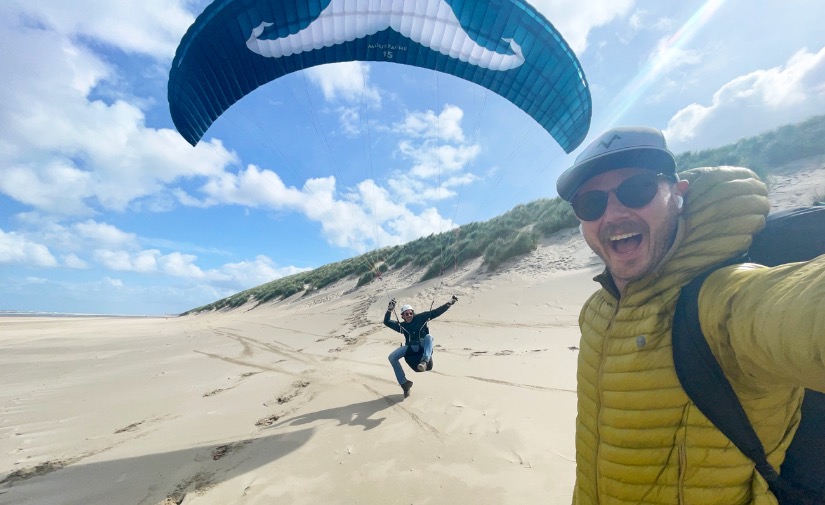
The Moustache comes with a biggest-grin guarantee:
What makes the Moustache so revolutionary?
Kitesurfers are used to depower: using the bar to generate more or less power and lift.
Until now, this wasn't possible with a paraglider.
But after 10 years of development, Flare has managed to build this principle into a paraglider.
For the first time, your hands decide how steep and fast you dive down and pull back up, and also whether you cruise at a relaxed 30 km/h or floor it to well over 70 km/h.
So your hands control the entire spectrum: left/right, forward/backward and down/up.
Flying in the third dimension!
That's why Flare calls its products Parakites: the technology is a fusion of two sports, paragliding and kitesurfing.
Holy sh•t, I want this, where do I sign?
Learn all about soaring, flaring and paragliding in this article, or skip straight to the bottom for the lesson options!
Video: Edwin Haighton - The Stoke Farm
Glossary / How to read this article
We could talk about paragliding forever, but maybe you're more into the quick version and the summary.
That's why we've split every topic into the quick basics and the longer (expandable) story.
That way you decide for yourself when to dive deep down the rabbit hole!
Paraglider, glider, rag, canopy, wing - All synonyms for the same thing: that thing above your head.
Riser - The 2 strong straps you clip into your harness, where all the lines and brake handles come together.
Flare system - The pulley system above the risers that lets you control the angle of the Moustache.
Mountain course - A comprehensive paragliding course where you learn to fly independently in the mountains and in thermals. After successfully completing it, you receive a pilot license that lets you fly insured outside the Netherlands.
(Frontal) collapse - a situation where the wing partly or fully collapses in flight and only partly supports the pilot, or not at all.
Back stall - a situation where the wing stops flying due to an excessive angle of attack (almost always pilot-induced) and falls "backward".
What is soaring? (And what is flaring?)
It's what you see seagulls doing!
Simply put, soaring is endless flying on wind that blows up against the dunes.
You can fly as long as that wind keeps blowing and as far as the line of dunes stretches uninterrupted.
With the Flare Moustache you can choose to skim low and fast along the dune or enjoy the view high above the dunes; 40 meters up is no problem at all!
Because the Moustache enables such a new way of flying, Flare named this new style flaring.
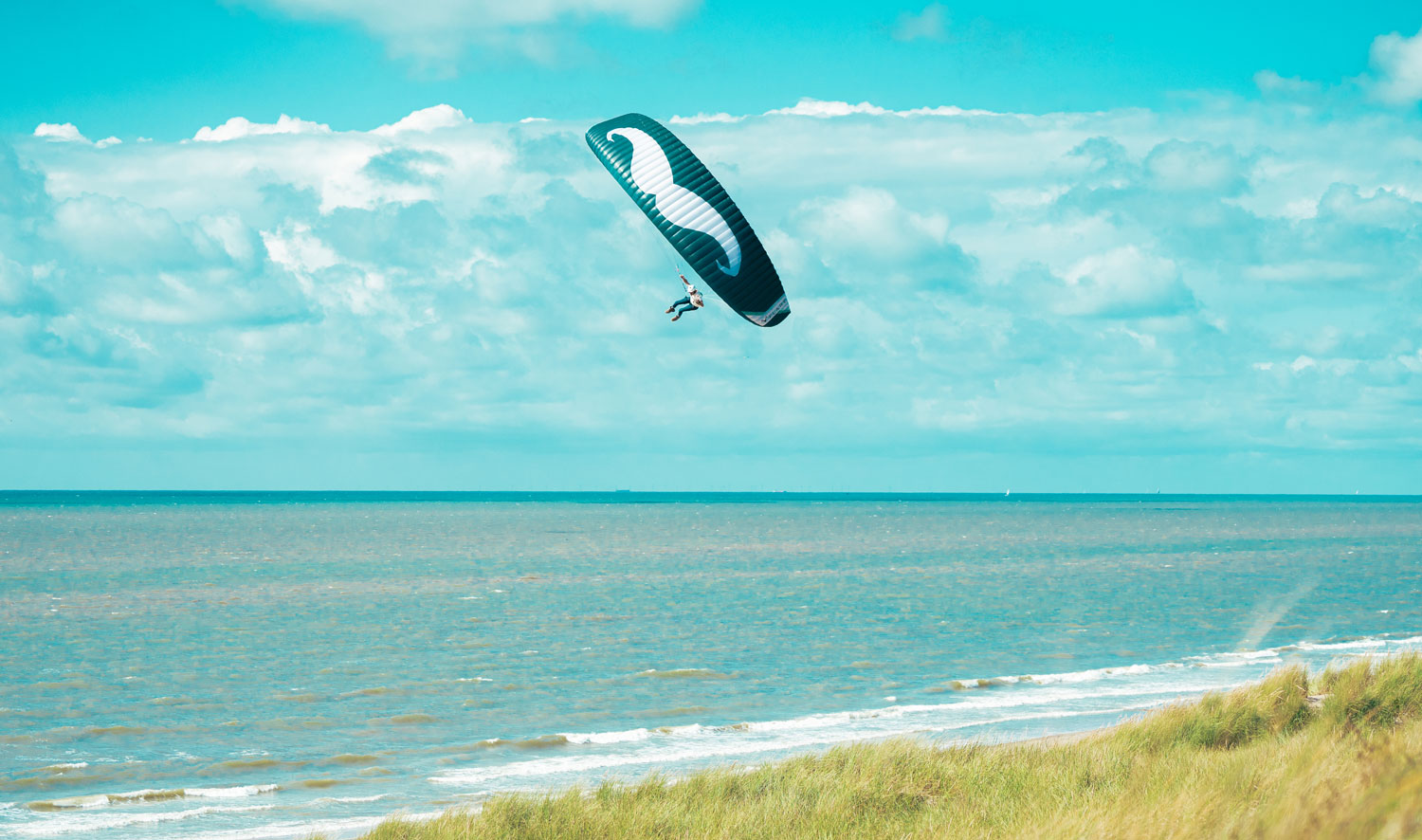 Photo: Ilyas Knauf
In paragliding there are different ways to stay in the air as long as possible using nothing but the forces of nature: ridge lift (soaring/flaring) and thermal lift:
When (sea) wind blows straight at a large object, it has to go over it. With dunes or a cliff or mountain, this effect is very strong.
The wind is pushed upward in front of the dune, so it actually blows slightly “upward”.
The steeper and/or higher the dune, cliff or mountain, the stronger this “up-wind” becomes, and that's exactly what we can use endlessly.
Just like the seagulls, we can then fly along the coast for as long as the dunes go on, because we're constantly being pushed back up a little.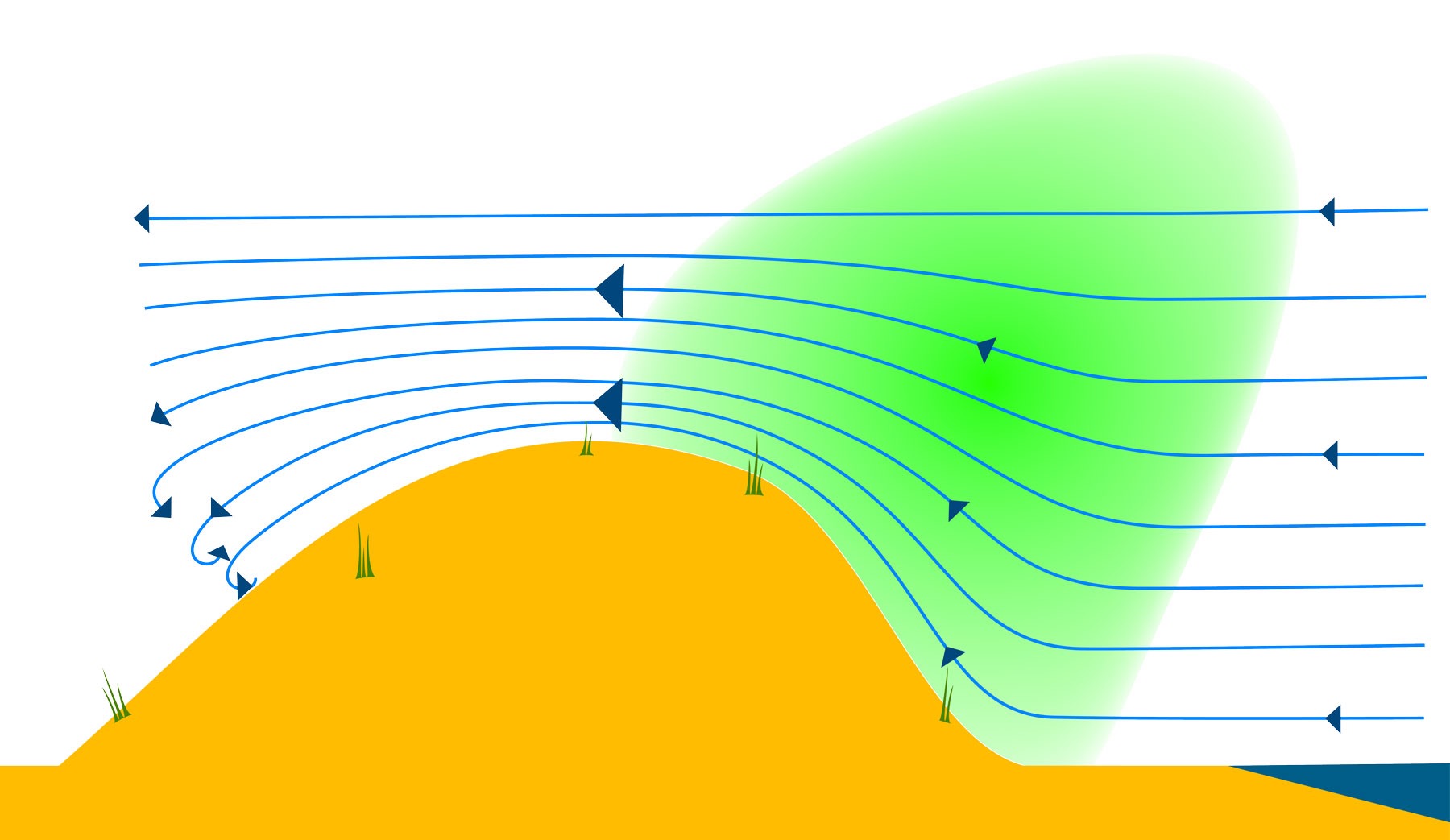
In principle, of course, any large object is “soarable”, but the wind hitting it needs to be as undisturbed as possible. Over the sea, the wind has many kilometers to become nice and smooth (laminar).
The more even and gently sloped the object is (without sharp edges or odd shapes), the more neutral and pleasant the lift feels and flies.
Many of our Dutch dunes are perfectly suited for soaring, but the steeper and higher the dune, the better.
You've probably never looked at them this closely, but dunes that rise steeply straight from the beach are the best.
Are there small dunes in front of the big ones? They disturb the lift and make flying a lot trickier, because each little dune only pushes the wind up a tiny bit.
By launching from a high point in the mountains (or getting towed up by a winch on flat land), you can search in flight for spots where the air is “bubbling up from the heat”.
These thermal bubbles rise from the ground and are so big and powerful that they carry you to great heights when you circle inside them.
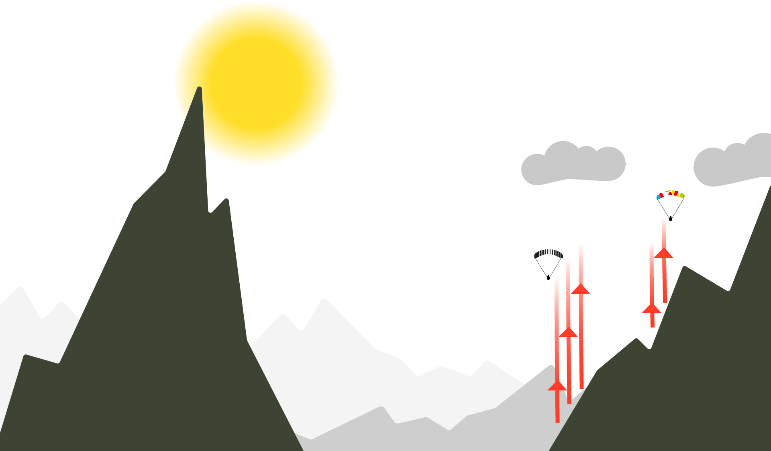
This way you can keep flying for hours and climb many times higher than where you launched.
In the mountains many birds use this technique, but vultures in particular have turned it into an art form.
Flaring (to flare) is a term that has been used in aviation for a very long time. It describes the technique of gradually bleeding off dive speed with brake input, leveling out parallel to your landing strip and then braking more and more for the actual touchdown. → Flaring the landing.
That's why even pilots whose name isn't Usain Bolt, but who fly small, blisteringly fast speedwings, can still land safely at a normal running pace.
Flare adopted this term because the Flare system (what's in a name!) makes extremely controlled flaring possible. You have so much control that with some practice you can “flare” for kilometers, something that was impossible until recently.
Why is everyone talking about the Moustache as THE paraglider for soaring over the dunes?
Compared to a normal large paraglider, the Flare Moustache's special pulley system (the Flare system) gives you a much bigger speed range within arm's length.
With your arms pulled in, the Flare Moustache flies calmly and efficiently and you stay high.
Arms all the way up (the hooray pose)? Then the Moustache dives forward and down like a roller coaster and everything gets a whole lot faster.
Video + camera: Edwin Haighton - The Stoke Farm
For soaring, that has 2 big advantages:
You can escape increasing wind or gusts much more easily.
You have far more control over that third dimension (height), so you can foot-drag along the beach endlessly or follow the contours of the dunes with centimeter precision.
And there's a bonus advantage for kiters: because the Flare Moustache is partly based on foil kite technology, kiters have a big head start when learning to handle this “mustache”.
When soaring you're constantly using the wind, and of course that wind isn't always the same, which puts big limitations on soaring with a normal paraglider.
It can be done, sure, but with a normal large paraglider your wind range is only about 7 to 8 knots, so there are lots of days you simply can't fly.
The wind can also pick up a bit during your session, and if that happens unexpectedly you can't just brace yourself against your board or the beach like you can when kiting.
With a normal paraglider, in a situation like that you quite quickly stop making forward progress, and eventually the wind slowly but surely pushes you backward over the dunes.
It doesn't help that the wind at the highest point of the dune is a few knots stronger due to compression.
Once you've been pushed behind the dunes, the wind there (because of the dunes) is very turbulent and rough (rotor and downwash), which means there's a high chance your paraglider partly or fully collapses in the air, a situation in which you can get very seriously injured.
Of course the Flare Moustache doesn't have unlimited speed either, but unlike normal paragliders, with the Flare Moustache you can raise your hands very high to instantly accelerate and descend.
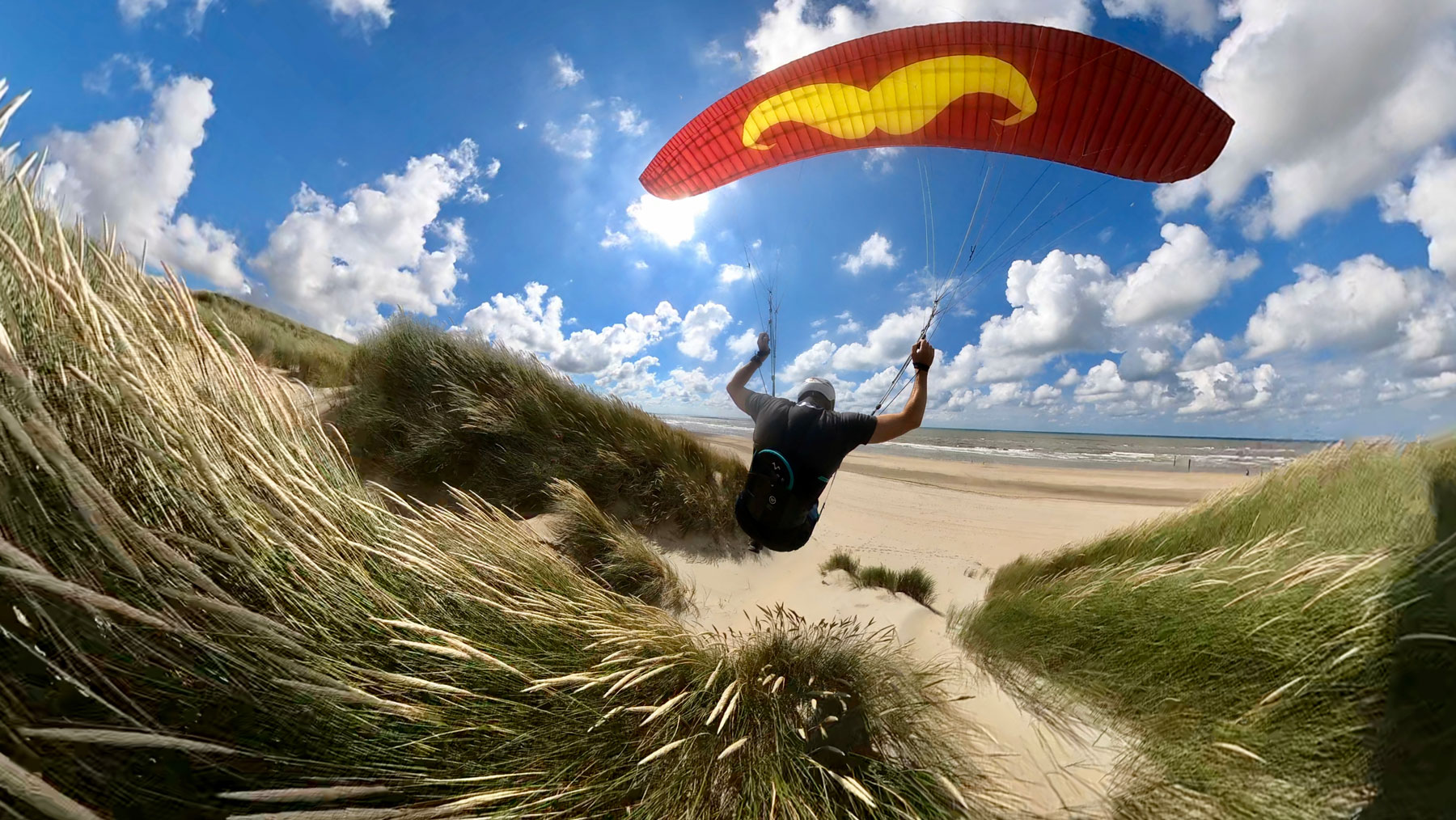
The Moustache's speed range (and therefore its wind range) is easily twice as big as that of normal paragliders, so you can keep much wider safety margins.
The chance of getting pushed back by increasing wind and compressed wind at the top of the dune is therefore much smaller.
With (foil) kites, kiters are used to steering and depowering as separate inputs that they combine without even thinking, and the Moustache works the same way. That's unique in paragliding, because a normal paraglider behaves more like a huge power kite without depower. Flying it, and especially keeping it up in the air while you're on the ground (“ground handling”), takes kiters some real getting used to.
So with the Moustache there's no need to unlearn anything, and we see that kiters get the hang of it relatively quickly.
Kiters with a solid foundation also often sense intuitively when they've pulled the handles (just like the bar) too far (back stall).
Which wind directions and wind strengths are good for soaring?
Dry weather, some nice sunshine and a breeze between 12 and 16 knots that (very important!) blows straight onto the dunes: THAT's the recipe that makes every soaring pilot start canceling everything else in their calendar.
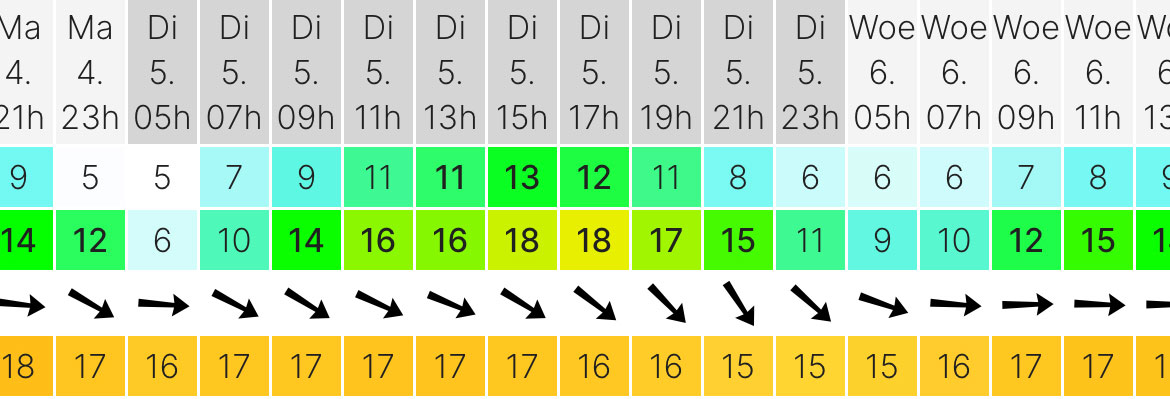
These are the days when it's party time for anyone with a wing in the trunk.
But phew, that's pretty specific, why so specific?
The wind is then strong enough to fly above a nice line of dunes, but still very even, so you fly really smoothly, calmly and safely.
For the right onshore wind direction you can of course drive to a dune the wind is blowing straight onto, but for some wind directions that's not so easy. So a nice NW wind for South Holland really means GO GO GO!
The Moustache works on the same basic principles, of course, but its innovative Flare system gives you 2 important extra trump cards for when the wind isn't quite ideal:
- Compared to classic wings, you can safely fly the same size in a controlled way in considerably more wind.
- You can fly larger crosswind angles when the wind isn't exactly straight onto the dune, although this does take experience and technique.
This means you can fly more often in terms of wind direction and strength, and get more out of every session!
 Photo: Ilyas Knauf
Before the Moustache came along, days between 12 and 16 knots were THE soaring days.
Everyone who soars has a wing for that wind; if it blew harder, you needed a second, smaller wing.
The range of that smaller wing (often called a mini wing) is roughly 17 to 23 knots.
Only a small share of soaring pilots own one, because flying in that wind is a lot more demanding.
The wing reacts quickly and directly, and the wind isn't just stronger but also a whole lot more turbulent.
On top of that, with wind between 15 and 20 knots you constantly have to weigh things up and switch:
Go big, and you risk ending up behind the dunes when you're at the top of the dune where the wind is strongest, or in a gust.
Go small, and you're constantly at the bottom end of the wing's range, where a back stall is lurking.
The Moustache pretty much combines the wind ranges above into one wing: with a total weight of 80 kg, you can easily fly the 18 from 13 to 22 knots.
This wind range is truly unique, and combined with the right decisions from you as a pilot, it makes soaring safer and more fun at the same time! Lots of factors play a role, but Flare has put the most common wind ranges in the chart below:
Keep in mind with these charts that paragliding always uses your total weight: so you add up your own weight, your clothing, any extra items going up with you, the weight of your harness and the weight of the paraglider!
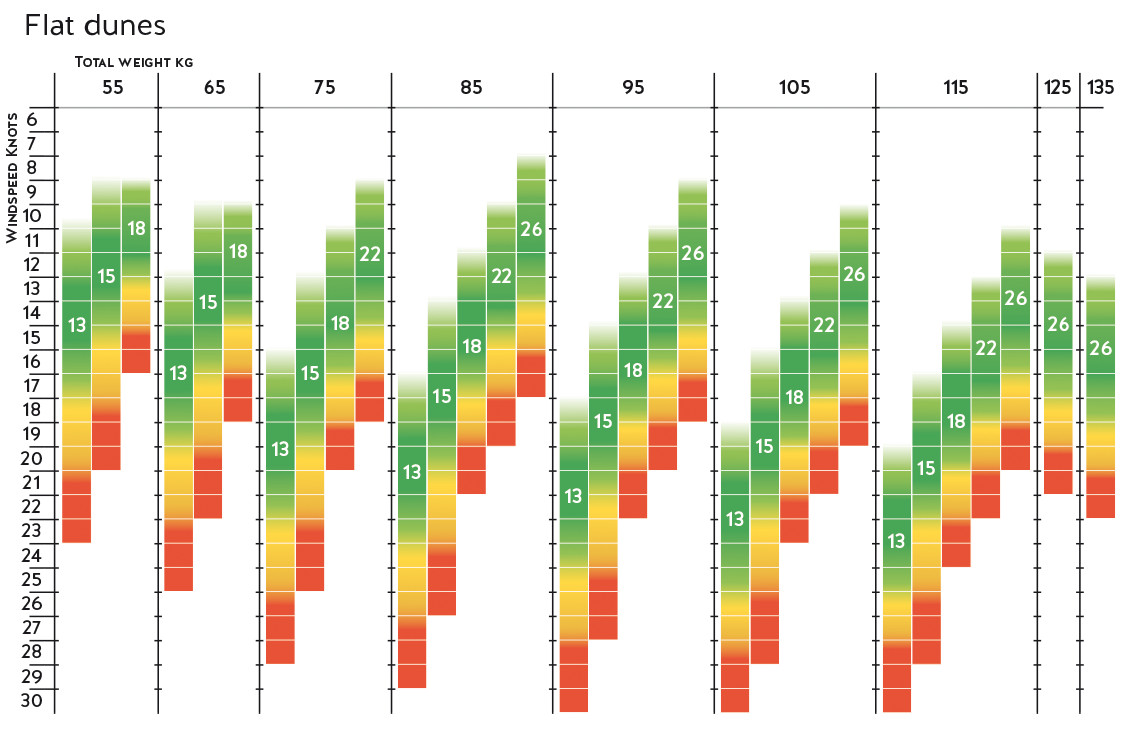
At the lower end of the wind range you'll see a transition in the green: in light wind, whether 11, 12 or 13 knots is flyable depends heavily on your skills, your preference and the shape/height of the dune.
On the other side of the green you'll also see a transition: in strong wind, besides experience and skills, the amount of turbulence (such as gusts) is also decisive, so there's no hard line to draw.
Flying in strong wind demands a lot from you as a pilot, and these are conditions where your reactions need to be trained through lots of flying hours (in lighter wind).
If the chart shows something, it means the wing is ready for it, but that doesn't mean you are!
The yellow fading into red (for advanced pilots) has a hard stop line. That's because you eventually reach a point where the glider's maximum forward speed can no longer overcome the wind speed (pushing you back), so you… that's right: fly backward.
Where that point lies depends on many factors, but it's clear you don't want to go looking for it.
It's so simple and logical, yet really important to realize: when you're hanging in the air, you can't push off or brace yourself against anything.
Once the wind gets so strong or gusty that you can't play with it anymore, it automatically starts playing with you.
A rough rule of thumb: for every knot the wind picks up, turbulence increases twice as much.
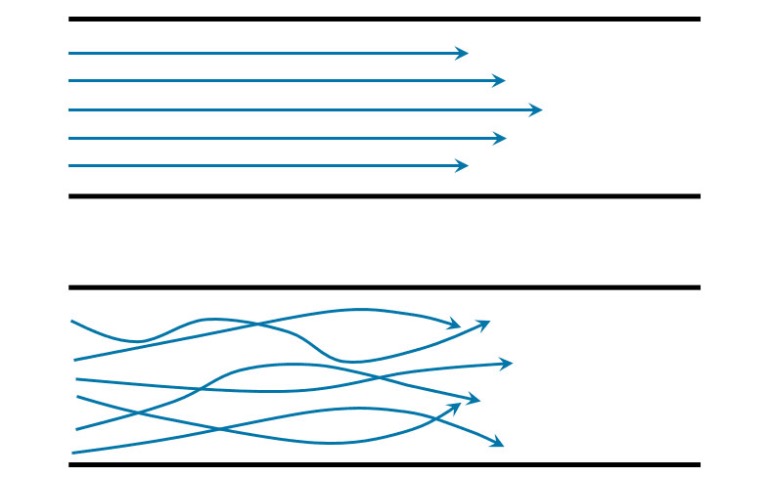
Between 12 and 18 knots, the wind coming off the sea is often very even in character. Even though you're flying on the wind, it feels really smooth, and any turbulence is mainly caused by very obvious objects (such as fellow pilots flying past in front of you).
From around 16/18 knots, that starts to change: you notice your paraglider no longer always flies nice and calm and taut; it shakes, flutters and starts to “buck” a bit more.
These are the conditions where you as a pilot have to “fly actively”: you need to keep your paraglider under control and in position above your head more actively.
From 23 knots, the chance that the wind becomes not just stronger but also very turbulent is very high, and that's decisive. It asks a lot not only of your paraglider's stability, but above all of you.
The gusts toss you around in the air like a ball, and your only answer is: fly very actively. This really is the wind range you shouldn't want to fly in or end up in as a beginner pilot (your first few years), not even on a smaller wing.
The same goes for big, heavy pilots who cruise around with ease when kiting and could do with an extra knot.
Without the right input for every buck your glider makes, you run a serious risk of collapses and crashes.
So you'll most likely have a completely different experience with a base wind of 17 knots gusting to around 20, compared to 19 knots gusting to 23.
There's also a fundamental difference between gusts and turbulence:
Even though they often go hand in hand, turbulence can also occur in airflow (wind) that isn't particularly strong or gusty. Friction between higher layers of air or, for example, waves at sea from a storm the day before can create turbulence (eddies) in the air at relatively low wind speeds!
The love story of the Flare system and the reflex profile
It makes sense that the Flare system (the pulley system above the riser) steals a lot of the attention on the Moustache.
But that's actually pretty unfair, because it's only 50% of the magic.
The Flare system of course lets you dive spectacularly or shoot upward with a simple movement of your arms.
But your wing still has to pull off that aerodynamic trick!
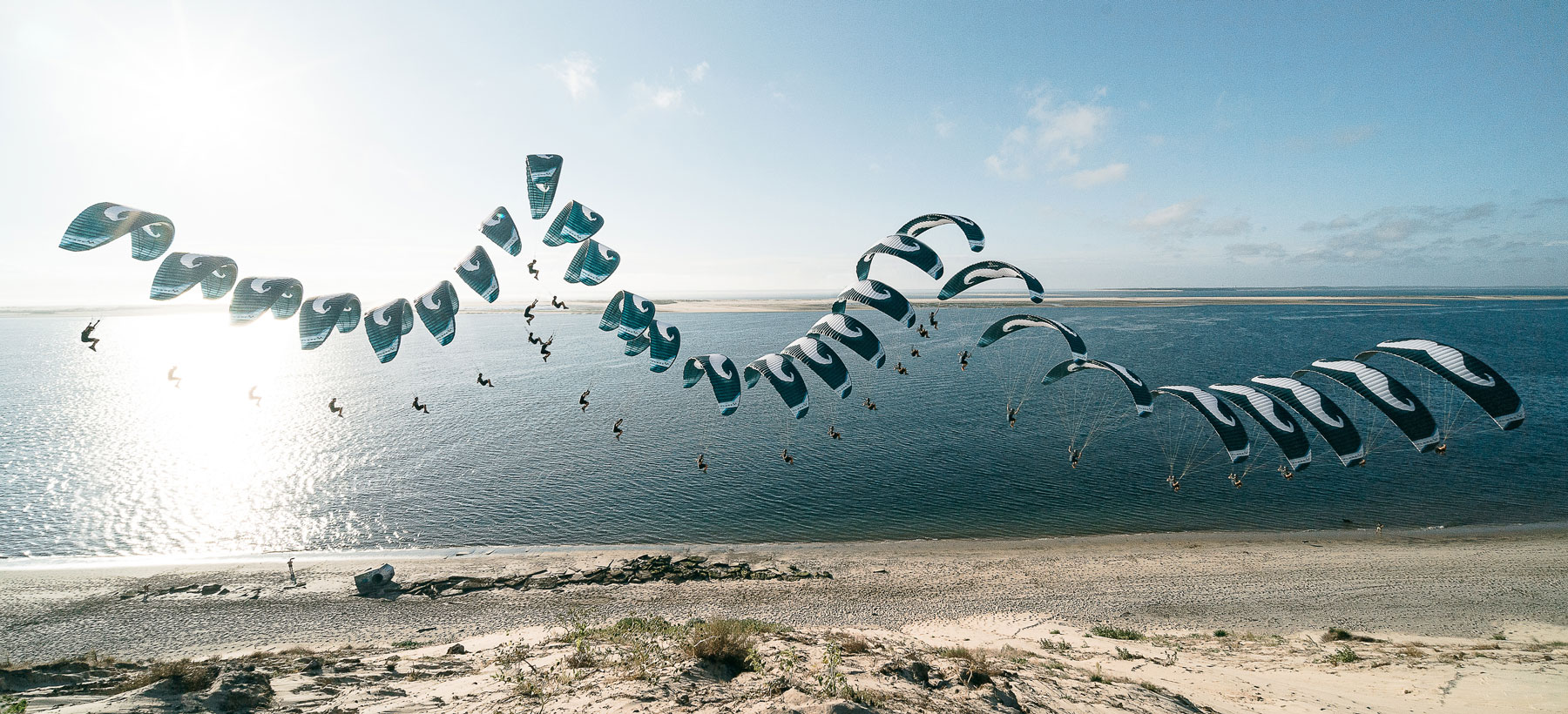
Without you even noticing, the reflex profile lets the Flare system shine.
This specific profile (the shape of the wing from thick to thin) is fundamentally different from other “normal” paragliders.
Without this profile, the Flare Moustache would only reach a fraction of its range, or collapse in many situations.
So it's precisely the interplay between the Flare system and the reflex profile that lets you rip with the Moustache in such a special, intuitive way!
To understand how this relationship works and why it matters so much, we need to dive into a bit of theory:
For the nose of the wing to collapse (a frontal collapse), you need negative pressure from above pushing the nose of the wing down.
With normal paragliders, this situation can be caused by, for example, thermal activity in the mountains, turbulence from flying past behind an obstacle (think of a beach bar) or a radical steering input by the pilot.
Because wind between 12 and 16 knots arrives from the sea so incredibly laminar (even), the chance of this happening above or in front of the dunes without an obvious cause is small (but never 0!).
Center of pressure (c.o.p.)
When an airfoil moves through the air it creates lift, more on some parts of the wing than on others.
The central point where the sum of all forces is 0 is called the “center of pressure” (c.o.p.); you can think of it as a kind of “pivot point”.
To get as much lift as possible out of the wing surface, on normal wings this c.o.p. isn't located right at the front by the nose.
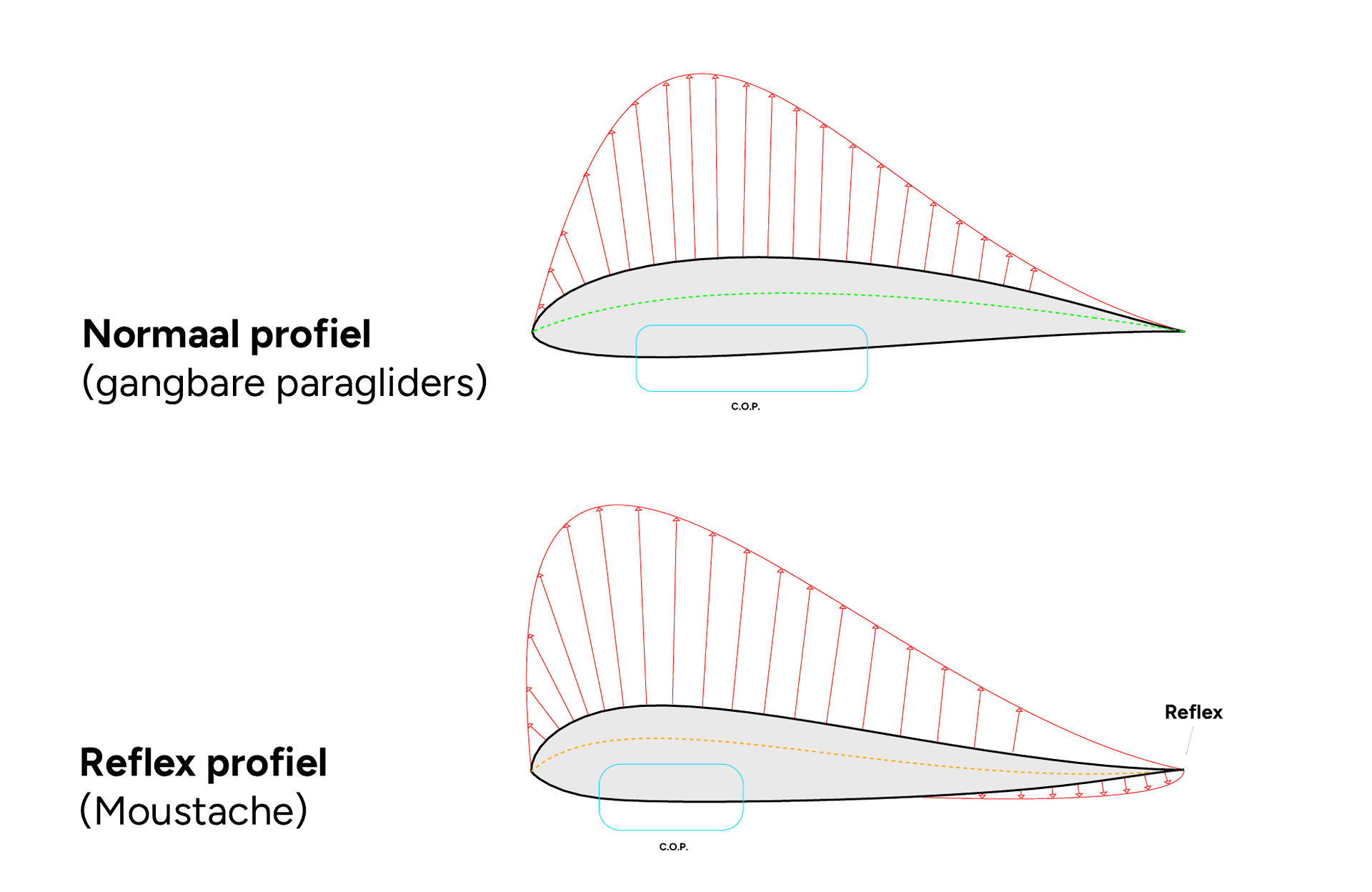
Illustration: Bryan van Ostheim - Moustachologist
Angle of attack (a.o.a.)
“Normal” paragliders are also designed on the principle that they fly through the air at a fixed angle (angle of attack, a.o.a.).
Only in specific cases (pushing the speed bar) do you deliberately fly at a slightly smaller a.o.a., which makes the wing temporarily a bit faster.
Because this angle is essentially fixed, the rest of the wing can be designed to be stable and the nose can be given enough (but not all) lift to stay open, even in turbulent air.
But with a wing like that, you as a pilot can only accelerate a little, so you don't get the freedom of the Moustache.
If you DO want the wing to dive really hard, shoot upward or fly very flat, AND have full control over all of it with your arms at all times, then a reflex profile is the ideal profile for the job.
So what's different about a reflex profile?
If you look at the cross-section, you'll see that a reflex profile is a lot thicker at the leading edge and can bend upward (negatively) at the trailing edge. (Now you know where the word reflex comes from.)
This gives a reflex profile a few “special powers”:
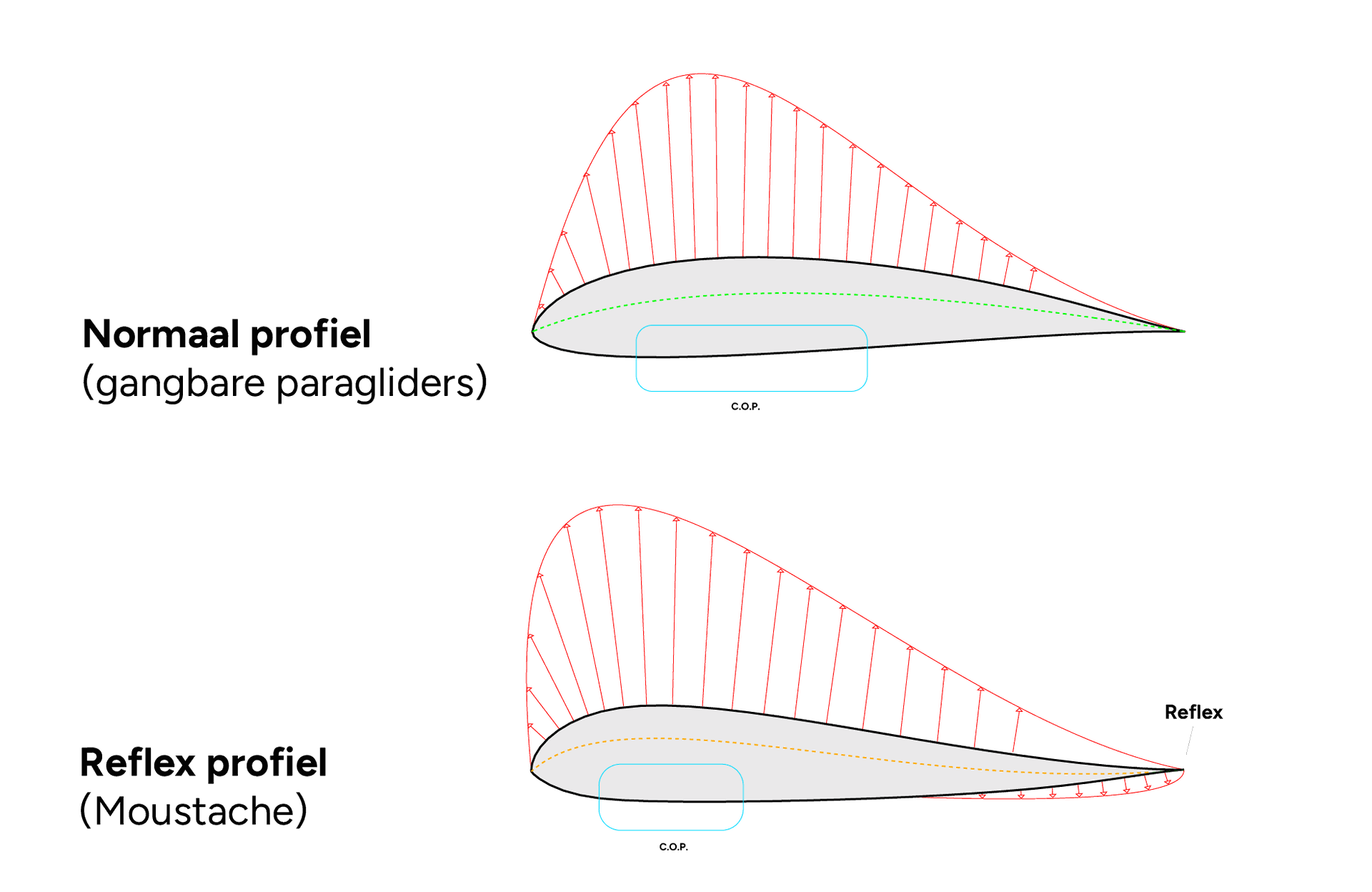
Illustration: Bryan van Ostheim - Moustachologist
In neutral trim (best glide setting), the c.o.p. sits much further toward the nose, so the nose of the wing is “held open” more strongly than on “normal” paragliders.
But the magic really comes to life when you raise your hands to dive as hard as possible and build speed. At that moment, the pulleys in the Flare system make the whole wing dive down.
Thanks to the different ratios in the pulley system (A=0%, B=16%, C=33%, Z / brakes=100%), the trailing edge also curls up extra at that moment, so your reflex catches more airflow.
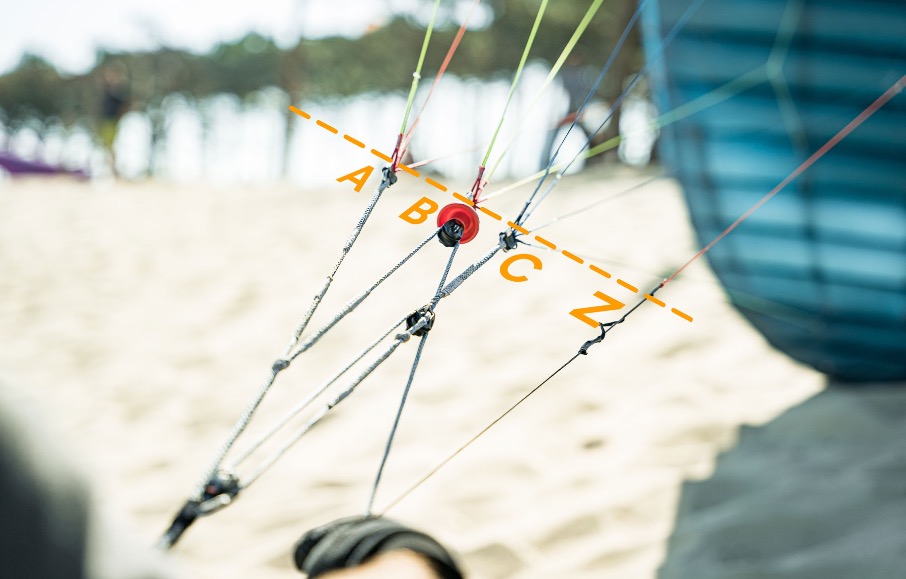
The reflex creates more drag, so the wing can't overshoot any further forward.
The trailing edge also pulls down slightly like a kind of spoiler, making the already stable nose even more stable.
And because lift increases along with airspeed, at higher speeds there's an extremely strong pull on the front/top of the nose, so the reflex profile actively and dynamically stabilizes itself.
This makes a frontal collapse very unlikely in laminar wind, even at the steepest angle, and in turbulent wind the chance is also significantly smaller than with a “normal” paraglider (but never 0!).
The reflex profile is essential for controlling and depowering your Moustache.
The dynamic ratio trick of the pulleys in the Flare system brings the Moustache's reflex profile fully to life.
And the other way around, the reflex profile lets you fly more safely across that entire incredible flight range!
Different paragliders, ways of flying and systems.
Be careful what you wish for…
With this article you're stepping into a whole new world, a world where you might soon want to learn to fly!
Not just jumping really high, but actually flying, in some forms easily for hours on end, and all without an engine.
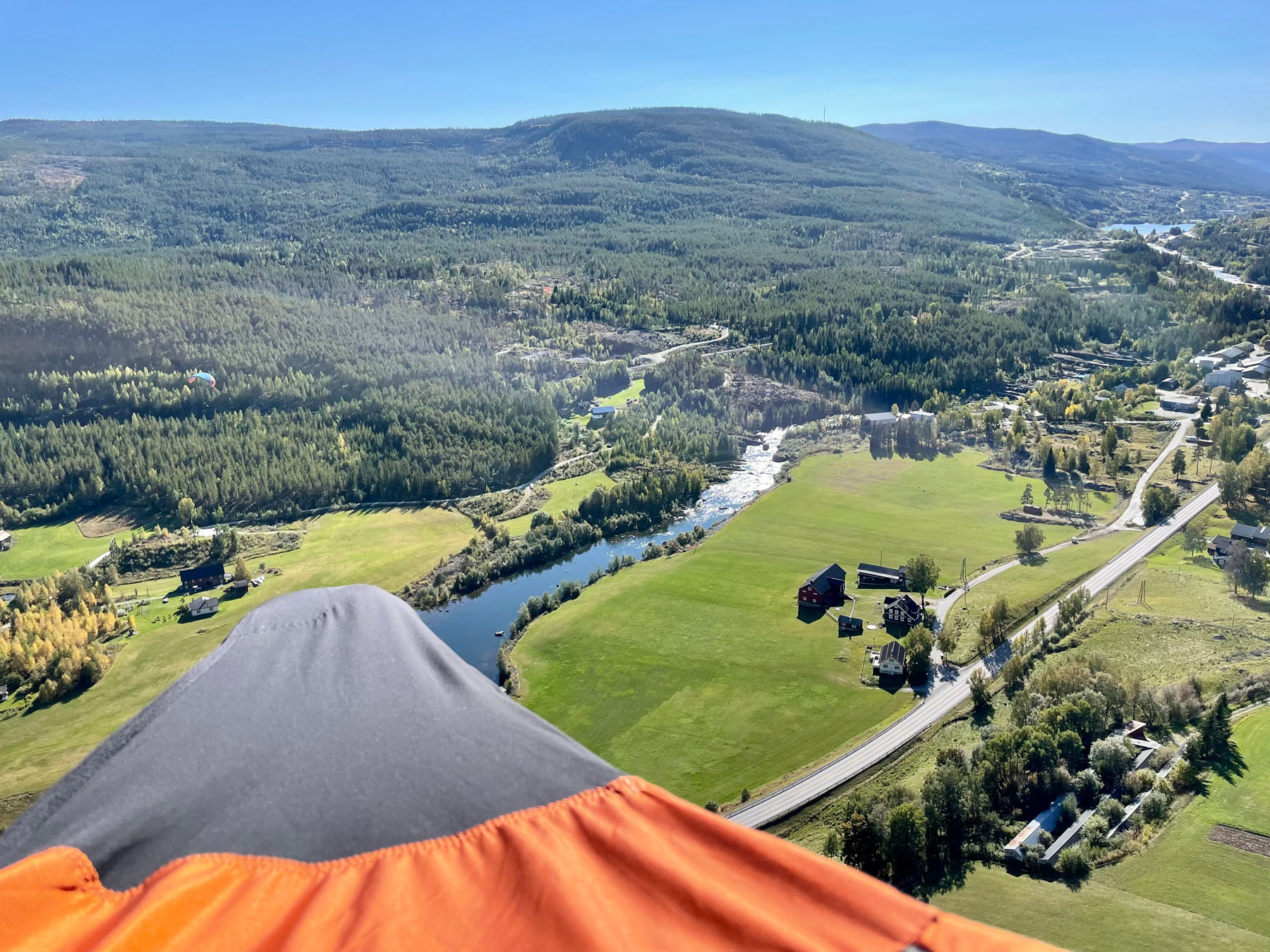
Just like kiting, paragliding has all kinds of cool disciplines.
The Flare Moustache is of course the ultimate paraglider for soaring, but thanks to its precise control over your height it also opens up unique new possibilities for speedflying and speedriding.
These are also the fastest forms of paragliding, where you fly at very high speed relatively close to the ground from the top of a mountain to a landing in the valley.
- Speedflying means launching and landing on foot
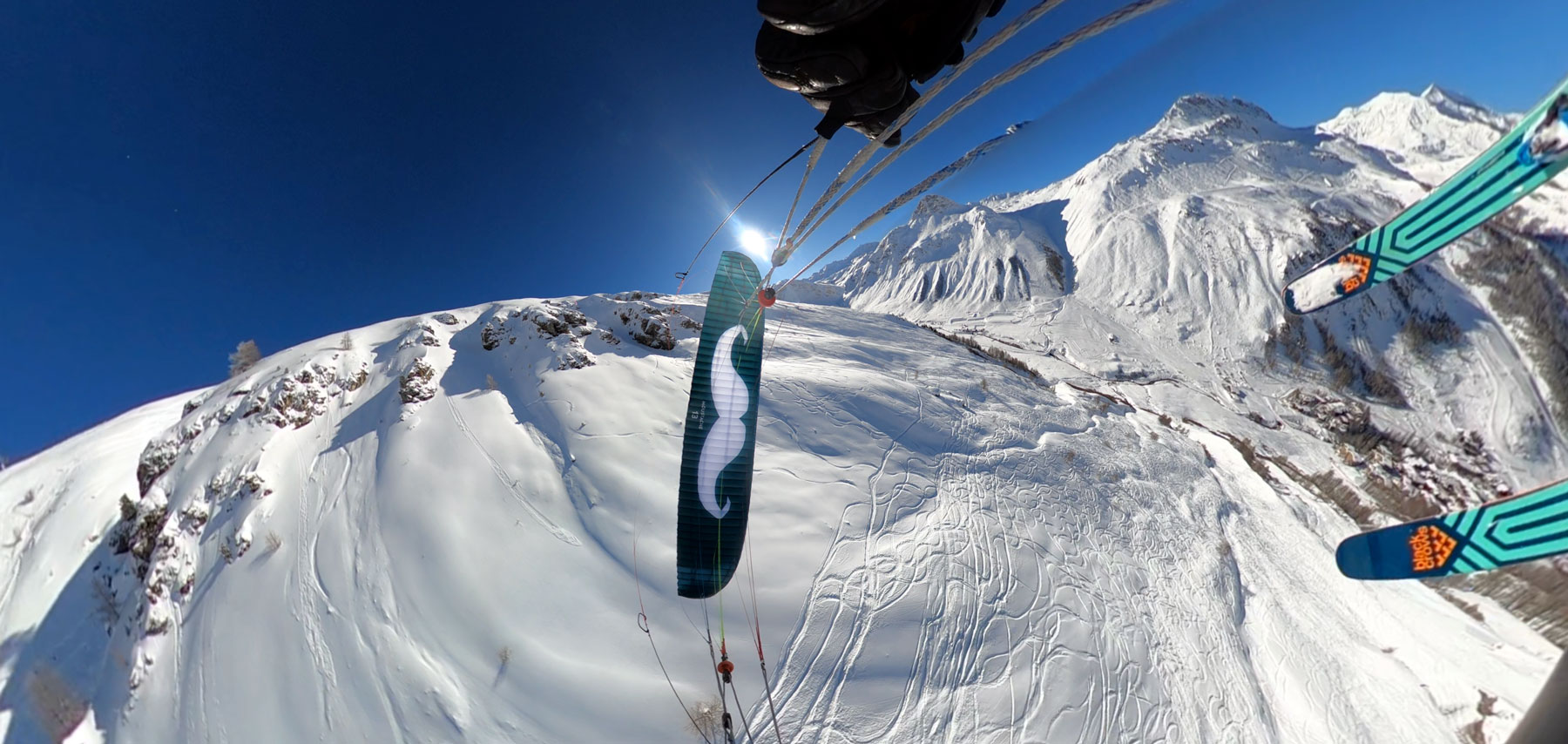
- Speedriding is done on skis, where the challenge is to combine flying and skiing in one run.
Speeds above 100 km/h aren't hard to reach, so making the right calls is literally a matter of life and death.
For these extreme mountain disciplines it's essential (and wise!) to be honest with yourself about your experience, skills and available time before you book lessons.
For kiters, the Flare Moustache is the perfect bridge between kitesurfing and paragliding, and with the soaring experience you gain, a great springboard to a mountain course!
But: soaring experience (with the Moustache or another wing) is absolutely no substitute for a course and a license for flying in the mountains.
Tell me more about those other disciplines!
Let's start at the beginning: paragliding has its roots in the mountains, over 40 years ago.
Back when wings were little more than sort-of-steerable parachutes, there were already some crazy (or brave) French pilots flying them from the summit down to the valley.
As the wings became more aerodynamic, it became possible to fly further and use thermals (bubbles or columns of rising warm air) to stay airborne longer. That was the birth of modern paragliding.
The wings kept getting more aerodynamic, and pilots got better and better at flying for hours from one warm bubble to the next.
Today there are competitions where pilots cover hundreds of kilometers a day using this principle!
The distance world record is currently held by Sébastien Kayrouz with 612 km.
It goes high, too: in the Alps, flying at 1500 to 3000 meters is nothing unusual for many pilots, but Antoine Girard briefly “tagged” 8407 m in the Himalayas for the world record.
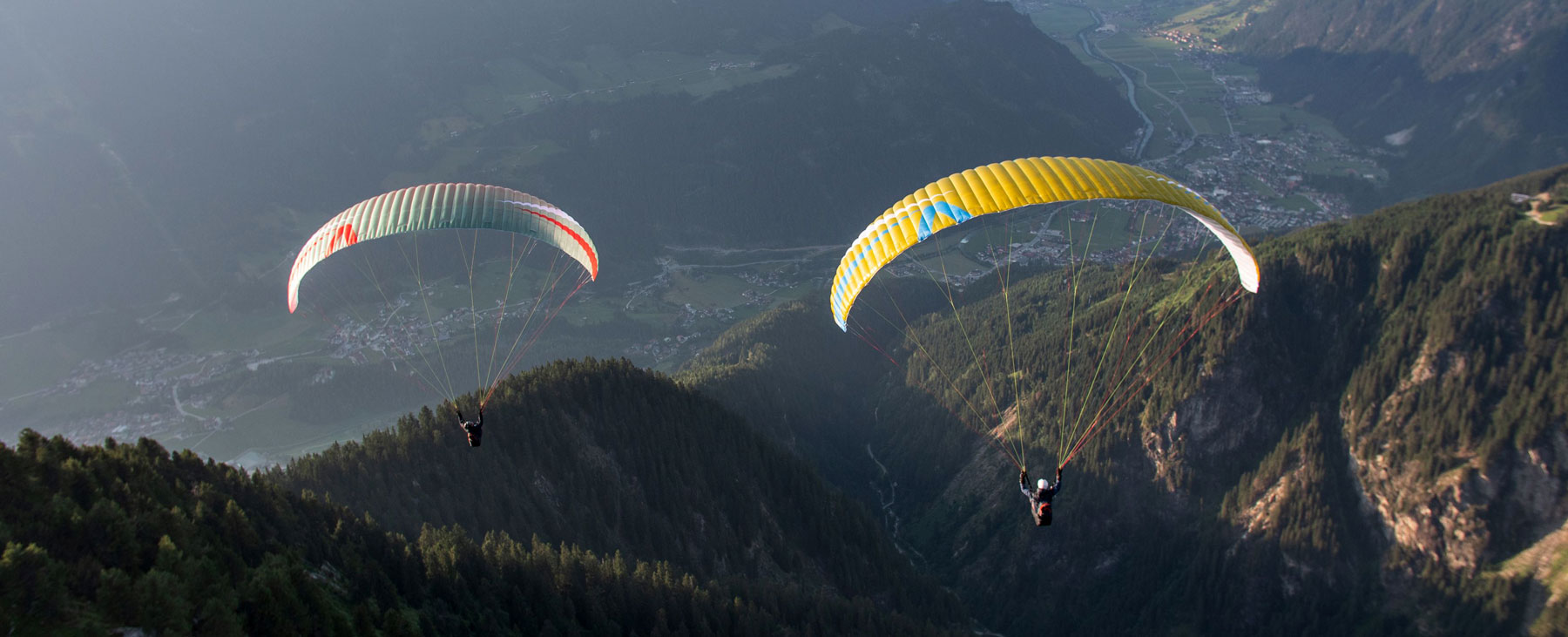
Recreational thermal pilots fly for the amazing feeling, the unreal views over the mountains and the constant game of chess with the elements: making sure you can fly as long as possible by watching closely, feeling carefully and making smart choices.
Flare actively advises against flying the Moustache in thermals.
An important reason is that the Moustache has to be handled in an atypical way after a collapse, and that the large angle-of-attack range amplifies the consequences of a collapse.
Because collapses are no exception in thermal flying, this combination of factors makes for a potentially very dangerous cocktail. We ourselves use a regular paraglider alongside the Moustache for flying in the mountains and in thermal conditions.
So how do you get up that mountain?
Sure, you can drive to the launch site, but it's a lot sportier to climb the mountain first.
You carry your wing, helmet, lunch/water and harness on your back, so after a long climb you can treat yourself to a flight down to the valley. Hike and Fly!
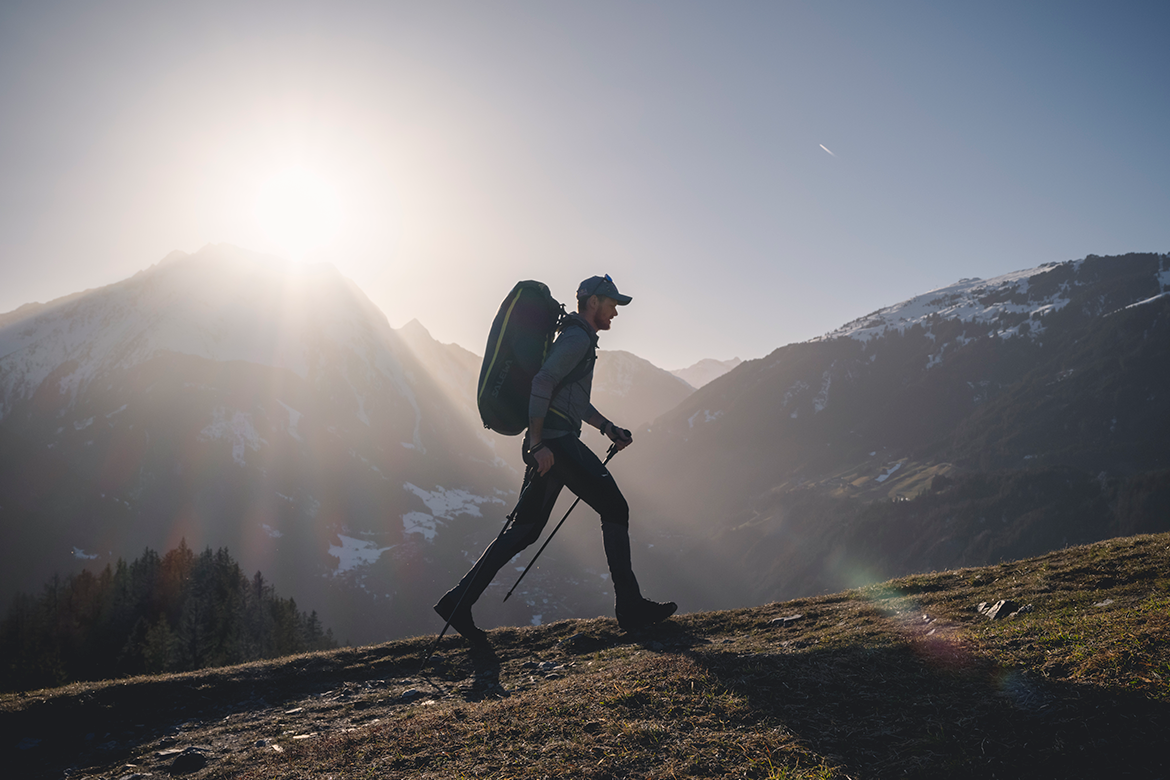
If you're lucky, thermals let you stay up a little longer, but after all that effort the flight down is the ultimate reward in itself.
Fancy something more radical?
Then we've got Acro on the menu:
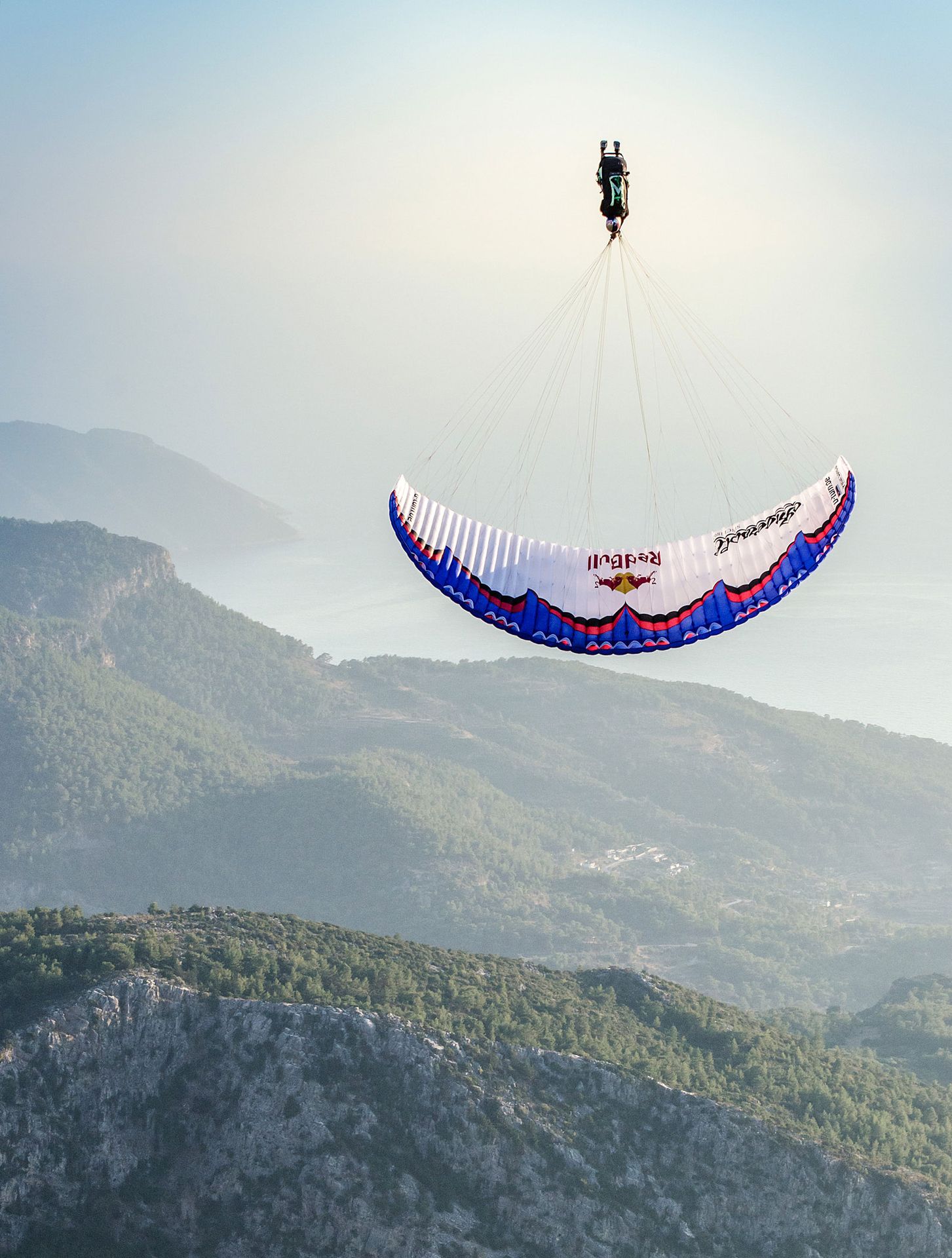
Very sensitive wings with extra-long lines let you pull off all kinds of radical tricks at high altitude.
This isn't an entry-level discipline and these aren't beginner wings: the slightest input makes the wing spin and twirl like a little propeller.
But acro pilots are constantly looking for ways to make their wing fly in unusual ways to pull off the craziest tricks and combos.
Thanks to the pendulum effect of the long lines, you can even fly (several times) right over your wing in the best-known extreme trick in paragliding: the infinity tumble.
There's a reason acro pilots often fly with 2 or 3 reserve parachutes in their harness. ;)
Are you the type who lives for speed!?
Then speedflying or speedriding are THE disciplines for you.
The two are very similar: you take a (much) smaller wing that's specifically designed to give control at high speed, and you fly as close as you can (and dare) over steep terrain, through canyons or (outside ski season) over deserted ski slopes.
The goal isn't to stay in the air as long as possible, but to blast steeply down at high speed and land at the landing spot within a few minutes, where you pack up for the next flight.
Adrenaline, endorphins, dopamine and a hefty dose of hyperfocus, dedication and self-knowledge: these aren't disciplines you do “on the side”.
If you make lots of flights and bring your soaring experience with you, the extreme and technical lines (flight routes) and tricks like barrel rolls will eventually be within reach.
In speedflying you have to run yourself, on launch AND landing! In flight your speed is so high that, logically, you fly the whole way (unlike speedriding).
Because thermals are a major danger (a frontal collapse at high speed close to the ground = serious accident), you can only speedfly when there's no thermal activity.
In practice this means speedflying is mainly done in early spring and autumn, when temperature differences are still small. You can also get up early, for example, to catch the first flight of the day just after sunrise.
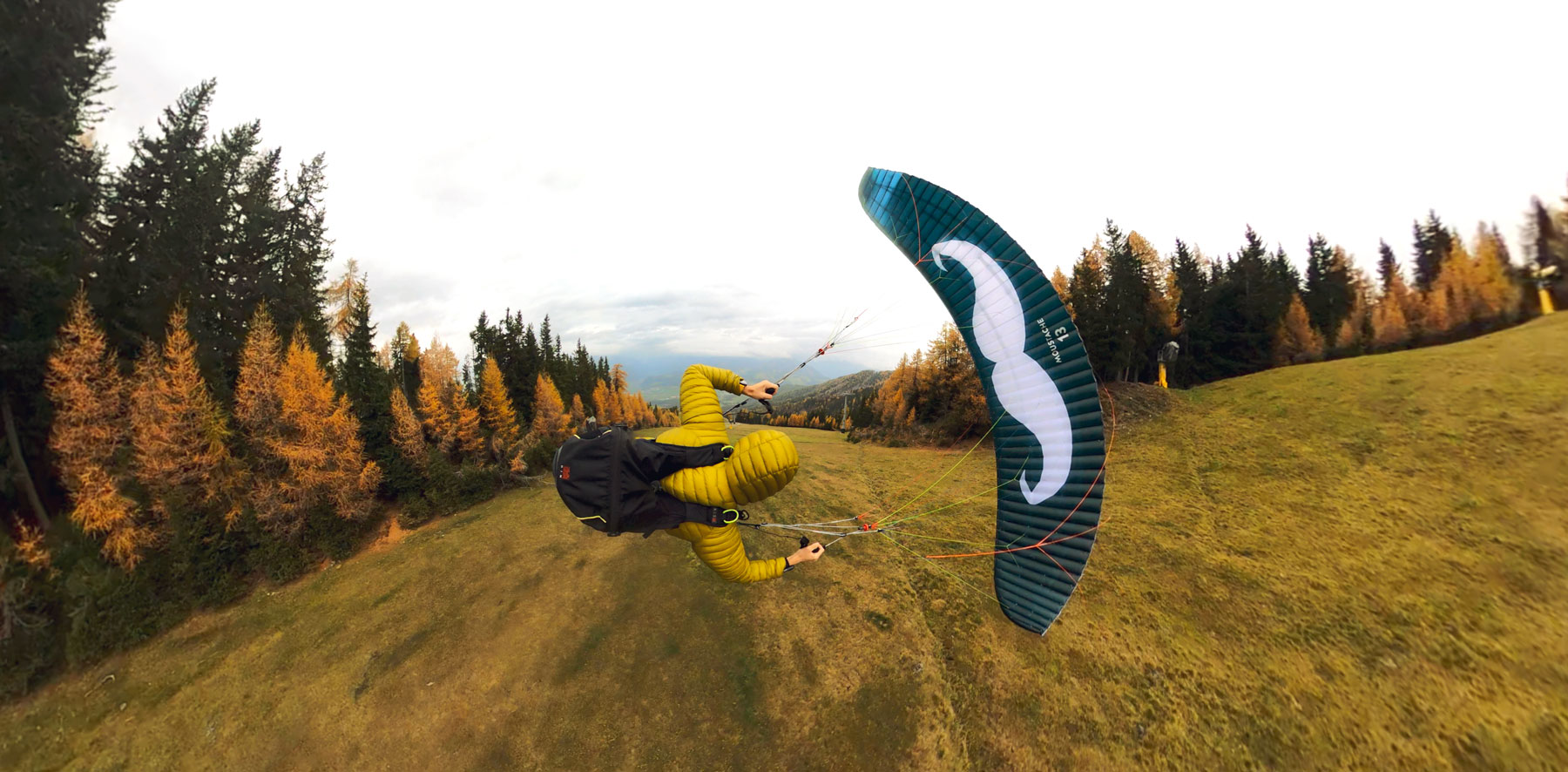
In speedriding you use skis for launch and landing.
This makes launching and landing much easier (if you can ski, of course), since most people can ski considerably faster than they can run.
Because this lets you launch even smaller wings, you can also stay “on the snow”.
You basically alternate between skiing and flying during your run. One pilot prefers to ski more and only fly the truly impossible sections, another enjoys the extreme possibilities and speed of such a small wing.
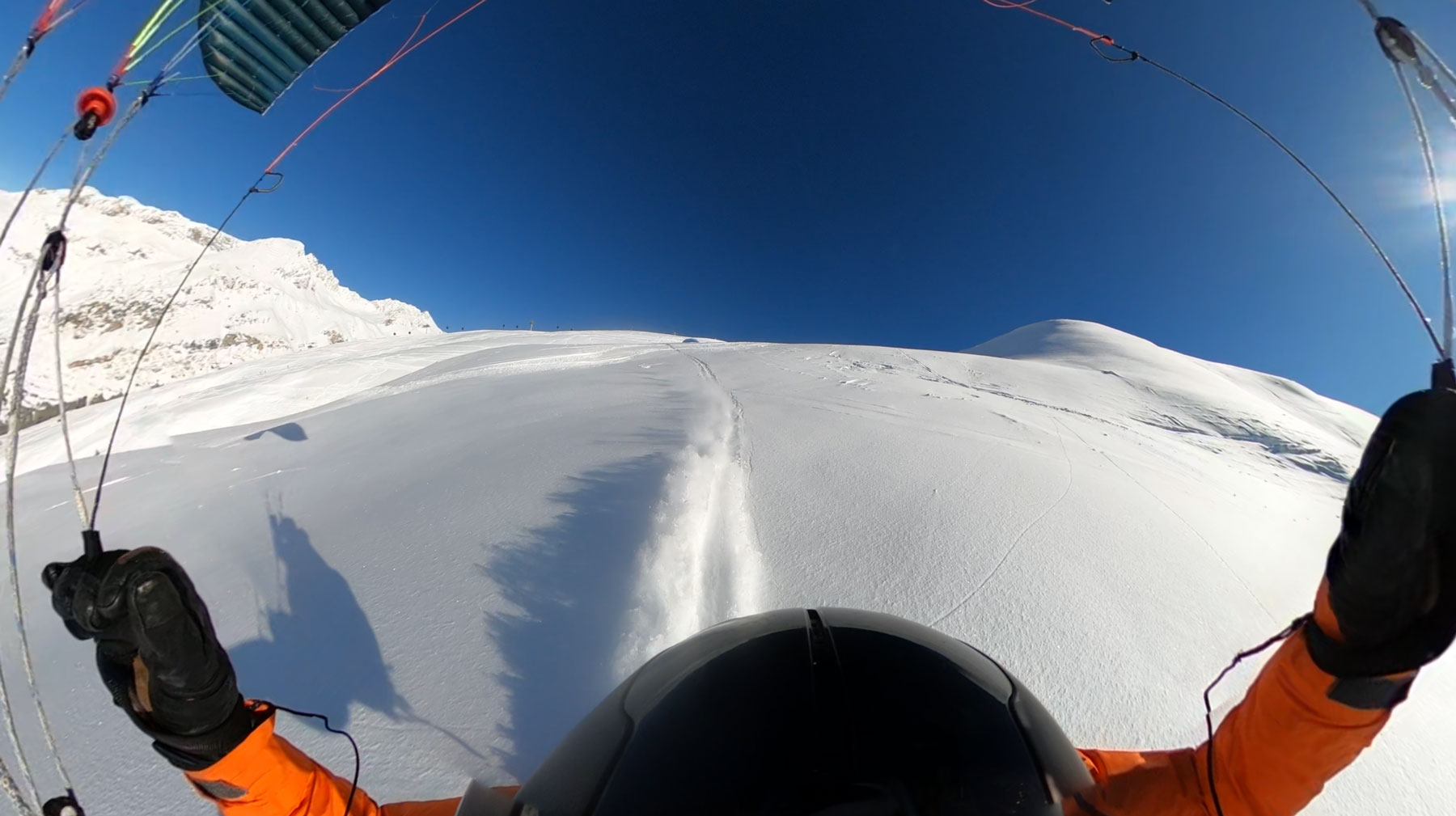
Both mini wings and speed wings are used for speedflying.
The difference is that mini wings are really small paragliders that are faster due to their small size, but can still fly relatively far because they “cut through the air well”.
That makes them better suited for soaring too.
They often have a higher AR (aspect ratio), more cells and a thinner profile, so they fly aerodynamically efficiently but are also more prone to stalls and collapses.
Speed wings are made specifically to go fast in a controlled way. Flying efficiently and far comes second.
They have a low AR, fewer and thicker cells, fill with air quickly on launch and have a very stable profile, ideal for some serious throwing around.
The Moustache wasn't specifically designed for speedflying and speedriding, but because it lets you control the angle of attack so precisely, it has quietly turned the speedfly/speedride world upside down as well.
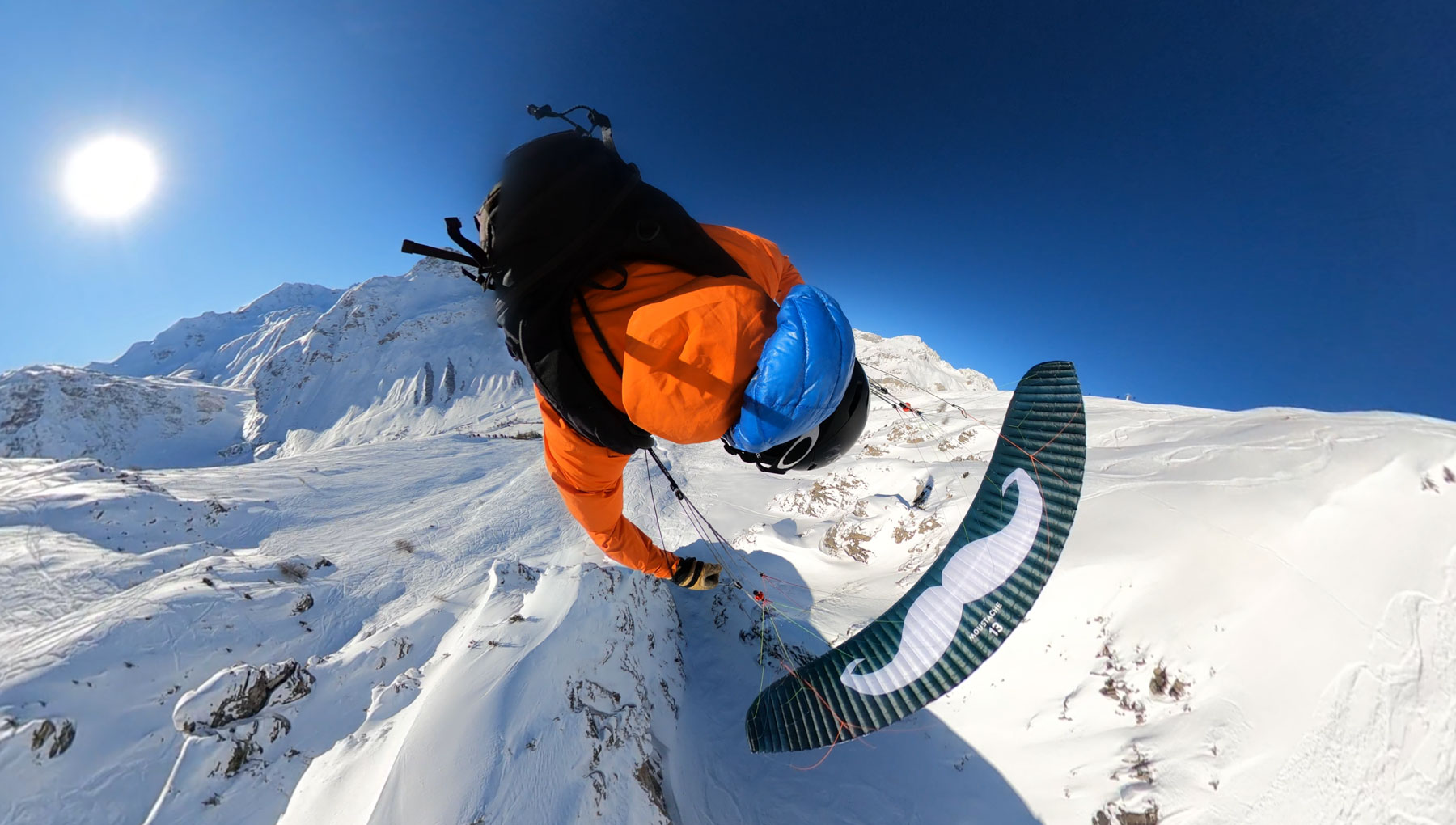
The reflex profile makes the Moustache more stable than mini wings, but thanks to its efficient profile and relatively high glide ratio (how far you get per meter of height lost), lines that once seemed impossible are suddenly flyable. With the Flare system you can “hop” over the less steep sections and obstacles in your line. This level of control is best described as: real-life Mario Kart.
For kiters, the Flare Moustache is the perfect bridge between kitesurfing and paragliding, and with the soaring experience you gain, it's a great springboard to a mountain course!
But: soaring experience (with the Moustache or another wing) is absolutely no substitute for a course and a license for flying in the mountains.
You've probably seen them: snowkiters riding up the mountain on skis or a board with their kite, then flying hundreds of meters down.
Looks awesome, sure, but with a kite, normal lines/bar and a kitesurf harness it's simply life-threatening.
The gear isn't designed or tested for it.
If something fails at those heights, you're heading for a wheelchair (if you're a bit lucky).
The Moustache IS designed for it!
Because you're using the wind blowing up the mountain, it's actually soaring, with the cool bonus that the Moustache does the towing for you!
That means you can combine flying and skiing in an amazing way. (Boarding doesn't really work well because you're standing sideways.)
You can keep flying, like at the dunes, but you can also fly down to the valley and then kite back up.
With the Flare Moustache you can handle the difference in wind strength between the valley and the top of the mountain thanks to its depower, and in practice that's THE big difference compared to a normal paraglider!
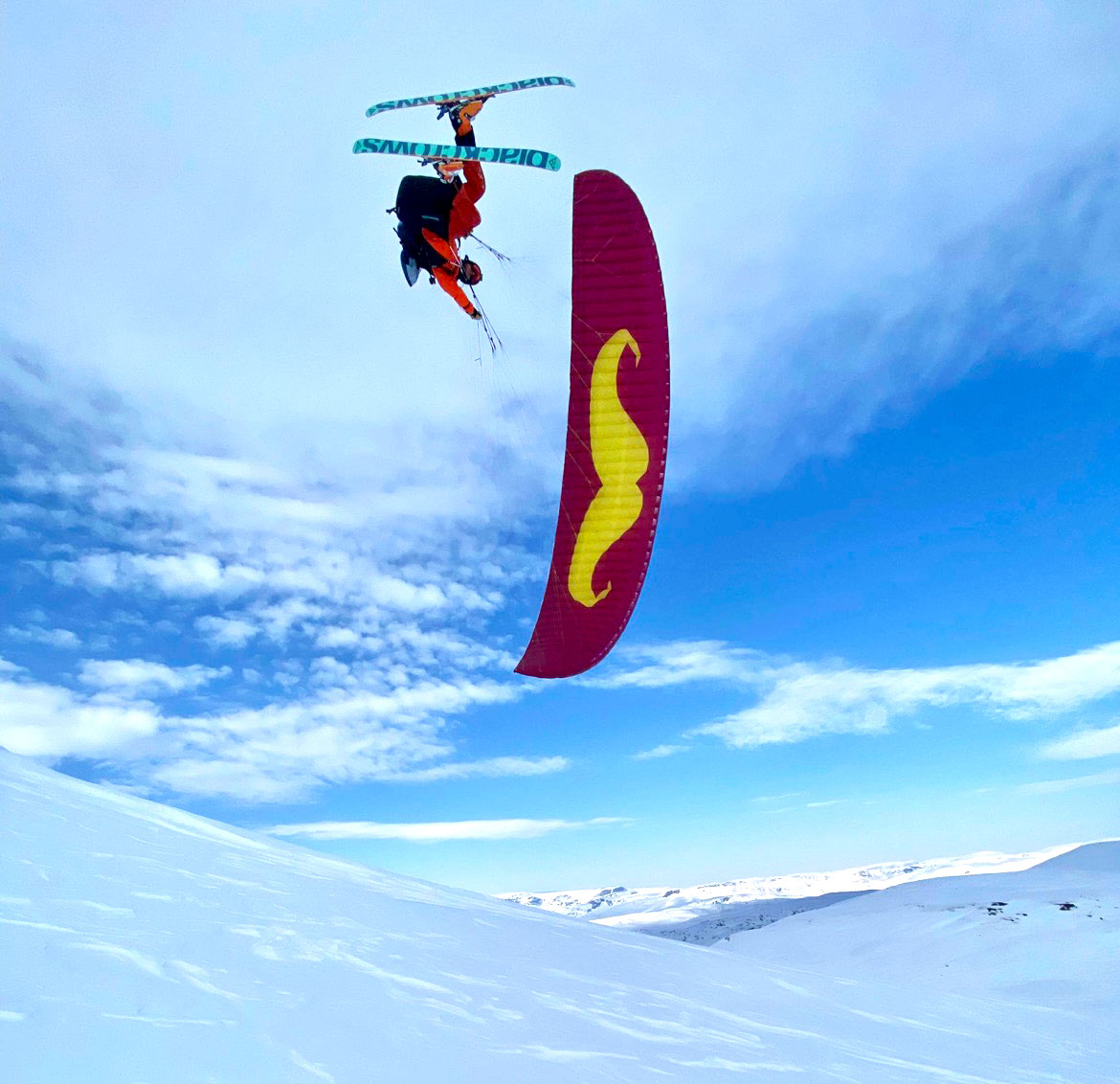
Soaring: differences between spots, low dune, high dune, small spot, big spot, etc.
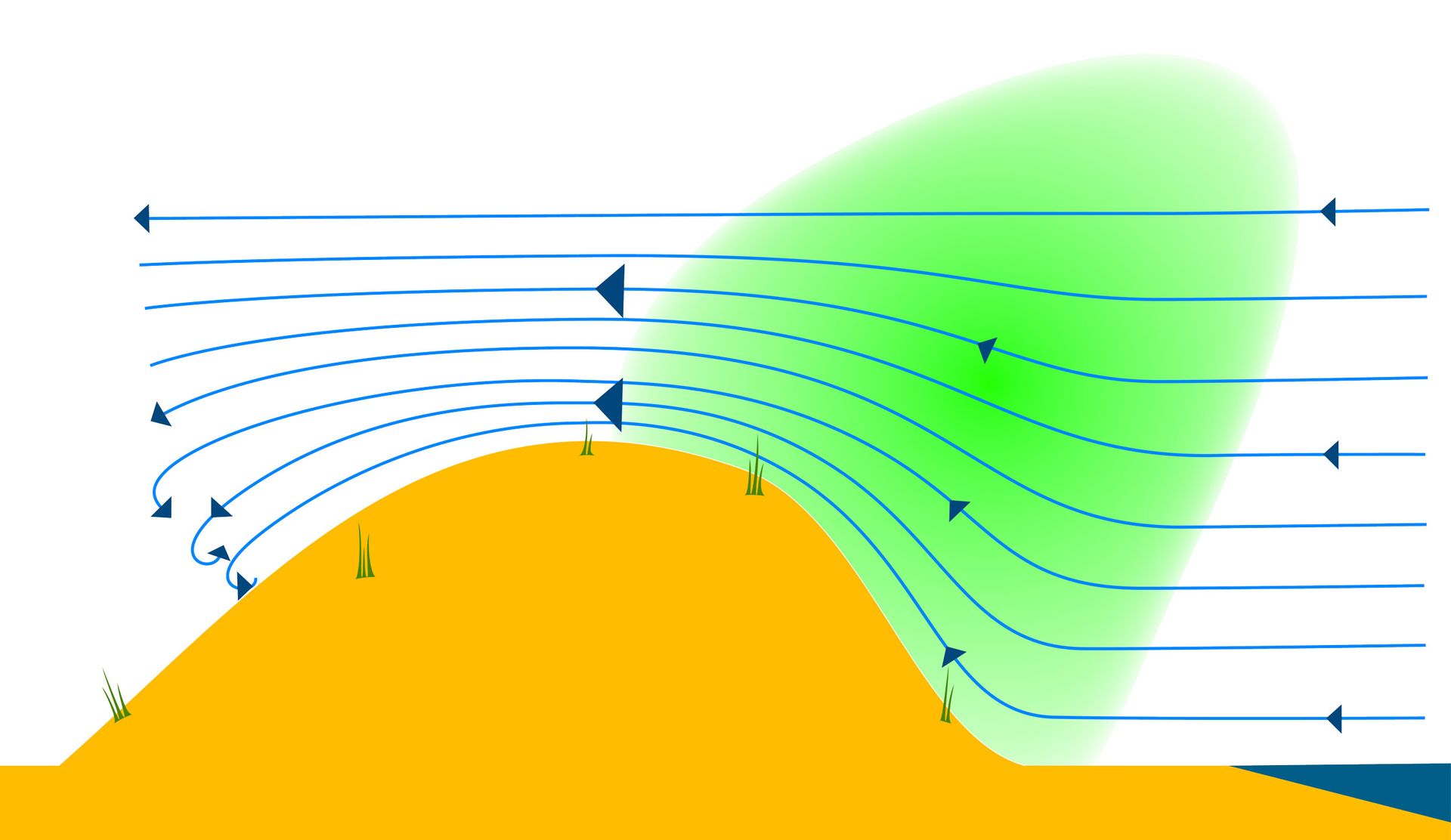
Wind coming off the sea can't go THROUGH the sand, so it has to go over the dunes, which pushes it upward.
It's easy to picture if you think of the dunes as a motocross ramp and the wind as a motocross rider tearing up the ramp at speed and going airborne.
The steeper, higher and more nicely shaped the dune, the better and more controlled the rider gets launched into the air.
That's how the wind is constantly pushed up, and you fly on that “up-wind”.
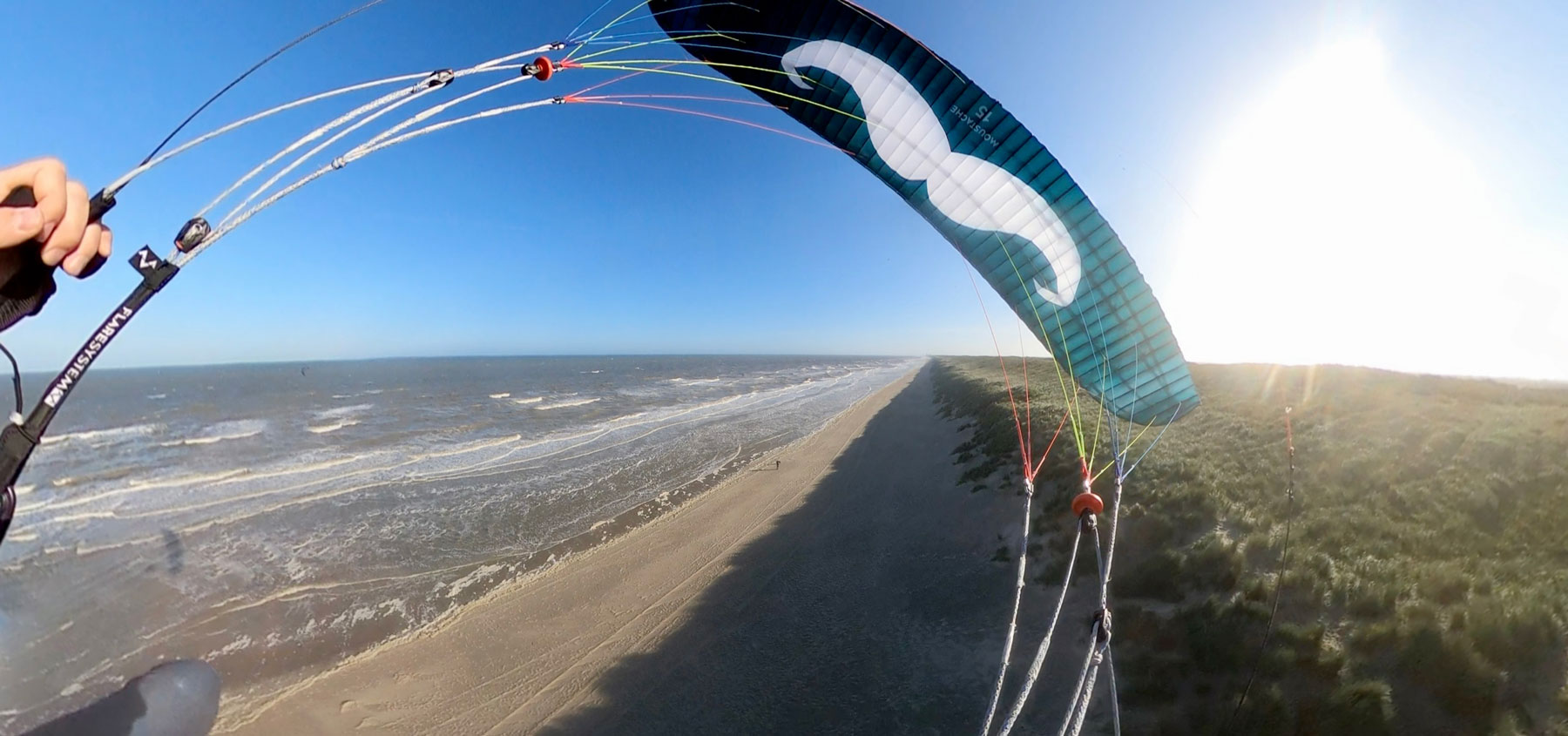
It really is an interplay of elements (shape, height, steepness, wind strength and weather differences).
In practice you'll notice that all those small differences create lots of flavors, between dunes but also from one day to the next or over the course of a day!
In soaring we call the zone where the wind is pushed up the lift band (the green zone in the illustration).
As long as you stay in that zone with the right wind, you can keep flying for hours on end.
The shape, but also the orientation of the dunes largely determines whether you can fly there.
If you want to fly often, every now and then you'll need to drive to a spot other than the nearest one!
Because you basically always fly above or in front of the highest point of the dune, you can only fly parallel to the dunes.
Along long lines of dunes, that can sometimes be dozens of kilometers: between Langevelderslag and Zandvoort, for example, or Wijk aan Zee and Egmond.
Of course you can also fly a bit further from the dune above the beach, or at high tide even a little above the surf, but you'll notice the lift stops and you need to get back to the lift band so you don't lose too much height.
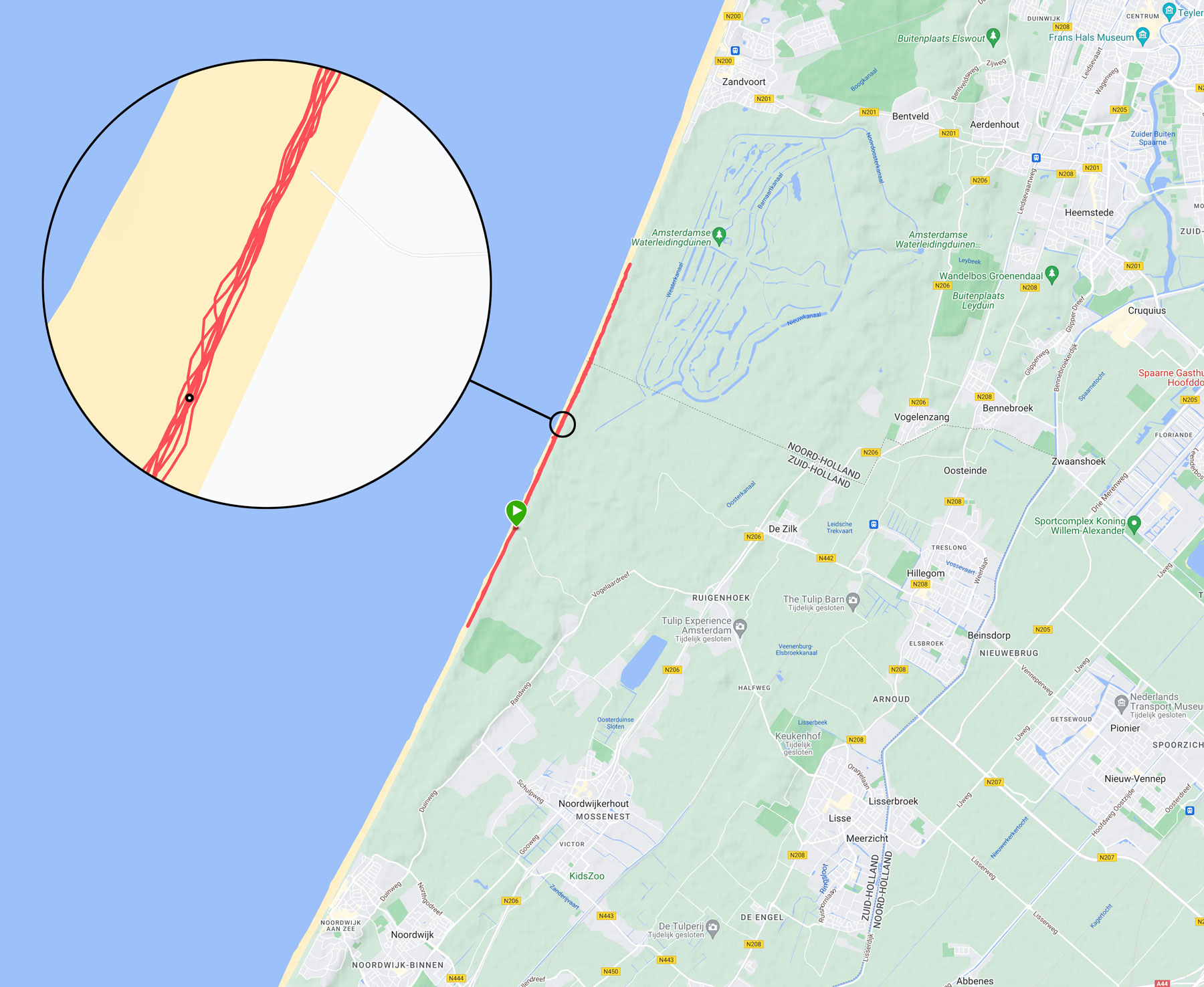
So it's nice when the line of dunes isn't just steep but also long and even. If there are big gaps or bad sections in the dunes, you only have a very limited flying area.
On your own that's not too bad, but with a few others the sky gets crowded fast.
And of course it's much cooler to fly for kilometers than to have to turn around every few hundred meters.
There are several places in the Netherlands with excellent flying: the dunes at Langevelderslag, Wijk aan Zee and Zoutelande are absolute hotspots.
These dunes are high, steep and even over a long stretch, giving you good, predictable lift and great flying.
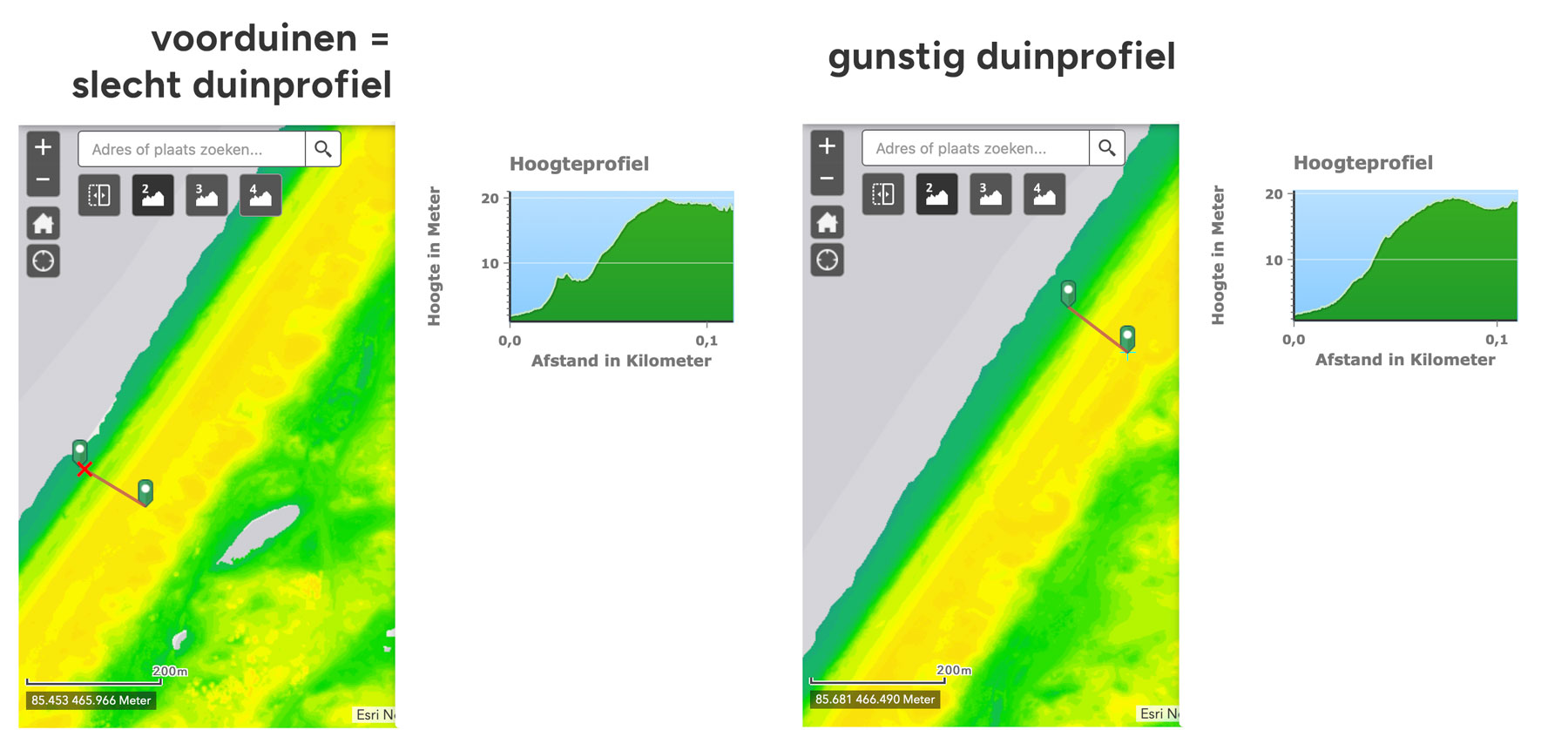
There are also plenty of places where the dunes are high enough, but the result is still poor because there are lower dunes in front of them (so-called foredunes).
These foredunes push the wind up less effectively, resulting in a noticeably weaker updraft.
The angle at which the wind hits the dune also matters: dead straight gives the best, strongest and easiest lift band.
An added bonus is that flying left and right goes equally fast, so you won't be surprised by a very high “downwind” speed.
Still, it's far from always perfect; sometimes there's a bit of an angle, which soaring pilots call “cross”.
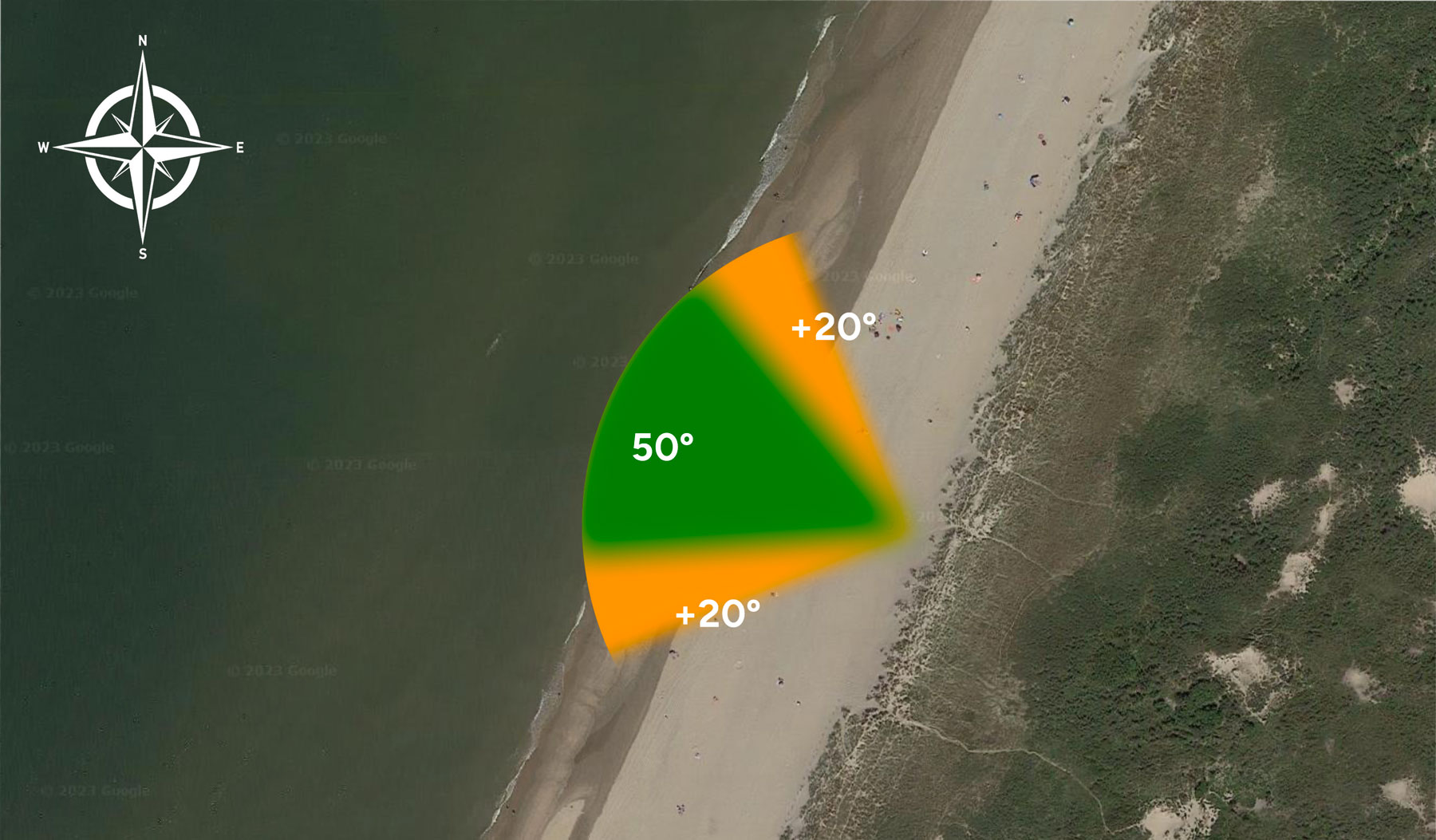
Luckily, the Moustache has you covered. With normal paragliders, a 20/30º cross angle can be enough to bring you to a standstill heading “upwind”. You can go really fast with the wind, but when you turn around after a good few kilometers at full throttle, you hang still and can't get back.
Because the Moustache lets you use its speed into the wind and its glide angle with the wind, you have more range.
As a beginner, 20/25º is very doable, and once you know your Moustache well after lots of flying, you can start extending that toward 45º.
Stay within your level and comfort zone, because the more cross, the narrower the lift band and the higher your downwind speed!
Risks
What goes up must come down!
Flying is amazing, and soaring above the dunes is one of the safer forms of paragliding, but that doesn't make it free of (serious) danger.
Only a relatively small part of safety can be solved with gear, and the majority of accidents can be traced back to pilot error.
It's your knowledge, choices and judgment, but also your experience(s), attitude and skills that let you make THE difference between life-threatening and no more dangerous than cycling through Amsterdam.
Unlike kitesurfing, learning to fly is largely about understanding how things work.
The fact that you as a kiter pick up flying the Moustache quickly is something you should consider a risk.
Kiters are used to impulsively trying all kinds of new things on the water because the water breaks your fall; falling is part of the sport.
In flying you can't afford that, not even a little bit.
In the theory lessons, as well as the practical lessons, we therefore go into detail on every aspect that influences your decisions.
Analyzing and evaluating are key parts of flying safely and getting better.
In paragliding you're constantly thinking a bit ahead to stay ahead of risky situations, and you can only do that if you understand the theory!
That knowledge also helps you better understand and apply situations that others have experienced.
By being and staying curious, you can keep expanding your knowledge; the more you learn, the better your decisions become.
That's why asking questions and taking time to share knowledge is a valuable custom in paragliding.
You'll learn a lot in our theory lesson too, come join us!
Paragliding is something you do within your comfort zone, and pushing it is very unwise.
By logging hours (and hours and hours), your comfort zone grows by itself, and in a safe way.
Enjoy the learning process and every flight; it's amazing even without pushing the limits!
Flying a lot, often and for long sessions, and filling every moment in between with ground handling your wing, is the only way to build a solid base of experience.
Every shortcut you talk yourself into will mercilessly trip you up at some point.
It's not a competition; there's nothing to win but plenty to lose if you try to go too fast.
Every flight gives you small and sometimes big experiences, all little puzzle pieces that make you a better pilot.
Experience doesn't come from a YouTube video, book or Insta Story. (Other people's experiences and knowledge do!)
A fundamental difference with kiting is that once you're in the air, you're part of the air (and therefore the weather).
Of course as a kiter you keep an eye on the weather during your session too, but we see that even with heavy squalls approaching, many kiters keep going and brace themselves in the water when it kicks off.
That doesn't always end well, and sometimes you wonder what's gotten into everyone, but surprisingly it rarely goes really wrong and usually ends with a few involuntary dunkings and a couple of pulled quick releases.
When soaring in the air there's nothing to brace against, and you certainly can't just pull your quick release.
With the example above we want to show: flying is very different.
To fly safely, you're constantly making assessments to base your choices on.
A better assessment = a better choice = a better outcome.
And who can you always call for that? Exactly: sidekicks Knowledge and Experience.
You are your own biggest risk; your attitude defines your choices.
That's why in paragliding it's a never-ending and confronting exercise to stay aware of your ego (and all its dirty tricks).
If you stay humble, eager to learn and critical of yourself, you'll have an enormous number of beautiful, safe flights,
but when everything's going well, it's tempting to start believing physics no longer has a grip on you, especially as the flying hours pile up.
Precisely because the Moustache gives you so much control, a good performance review with yourself every now and then is highly recommended.
Sure, there's Acro (see above), but for most people paragliding is much less about tricks than kitesurfing is.
That doesn't mean that once you're in the air it's just a matter of pulling a string for left and right, though.
By sensing disturbances in the air through your wing's reactions, you can control your wing with counter-input; this is called “active flying”.
With the Flare system there's always a bit of pressure on your arms, so as a Moustache pilot you're always flying actively, which is what makes the Moustache such a fun and dynamic wing.
For example, you'll get better and better at feeling where the lift is strongest, which turbulence needs your attention and where to position the wing for the perfect turn on a light-wind day.
Flying more and more efficiently, safely and smoothly is more addictive than you think!
What else do I need in terms of gear, skills and mindset?
Gear
Paragliding is sometimes called “the aircraft in a backpack”: a sport that basically fits in a bag the size of a kite bag!
For soaring/flaring the list is remarkably short: Moustache + bag, harness, helmet and possibly a wind meter.
You park your car or bike, walk to the launch, lay out your wing, check it, inflate it, and with a bit of practice you're flying within 10 minutes!
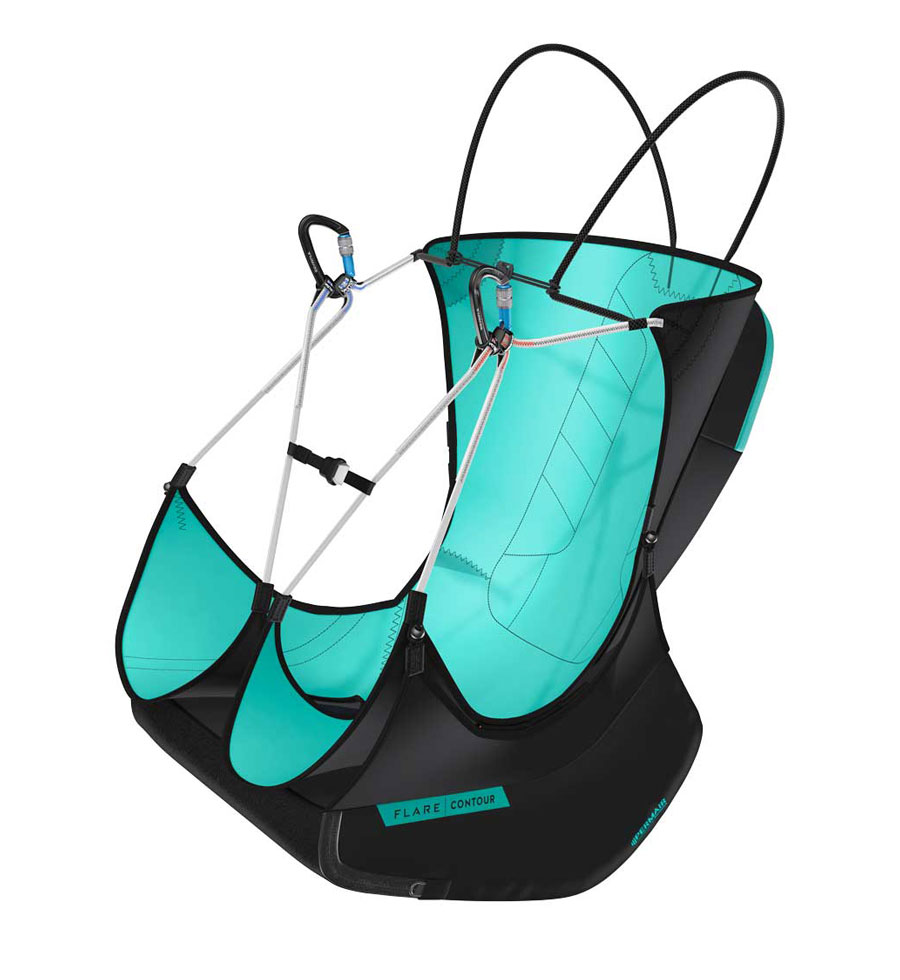
Flare developed the Flare Contour as a harness specifically for the Moustache. It's light and has an inflatable airbag to protect your back and tailbone.
Because your legs are supported via “split-leg” straps, it's very easy to feel the Moustache and steer precisely with weight shift (the Moustache loves that!).
There's also a small built-in backpack where you can stow the Moustache's bag during flight.
Because the Moustache has no speed system operated with your legs, the Contour has no pulleys, so you can't fully use this harness with a paraglider that DOES have a speed system.
A wind meter? Why? When kiting I always judge it just fine.
True, but especially at higher spots (Zoutelande, for example) or spots with a very different shape (cliffs abroad), it gives you a lot of confidence if you can measure the wind strength at launch.
You wouldn't be the first to misjudge it down on the beach, only for things to get uglier than you'd like at (or just behind) the launch or in the air.
Skills and mindset
You don't need kitesurfing experience to learn to fly the Moustache, but it definitely helps!
Because the Moustache was developed using (foil) kite technology, it feels very familiar to kiters, and as a kiter you only need a few lessons.
The environment is familiar too: as a kiter you're on the beach a lot and you recognize all the wind directions and weather conditions, so you can make good assessments quickly.
As described in the section above, mindset in particular is something kiters need to watch out for when soaring.
For safe flying in the mountains you'll need to stuff a few extra things into that bag, such as a reserve parachute, a down jacket, an altimeter, navigation tools, maybe a pee bag or pee condom, food and water.
Sturdy high boots are also nice (but you'll already be wearing those, of course), along with long pants for the tall grass and sunglasses.
In mountain flying you often see pilots choosing long sleeves and (thin) gloves (even when it's warm), because the lines can cut nastily during a mountain launch or when recovering from a collapse.
So in soaring it's worth considering flying WITH those two as well, but because we launch differently in soaring and with the Moustache your wrists are already in the loops, there's less chance of lines running over your forearms, for example, so it isn't seen as a real must.
As for mindset: it's an important, interactive part of our theory lessons, and you can also book those lessons if you already fly but would like to learn more about this topic!
Can I do this too? Where do I learn it? What does it cost? How long does it take?
You definitely can!
As a kiter you'll learn quickly and soon fly with confidence, which will help you with every step you take in this amazing sport.
Flying well (and enjoying it) means flying regularly, which is why mountain flying is hard to keep up when you live in the Netherlands, but soaring/flaring is possible here all year round!
If you've already gone over it in your head a few times and you're still excited (or getting more and more excited), then you're basically ready.
And the best part: you can learn it with us!
The course consists of 3 practical lessons and 2 theory lessons
€999
The first lesson, including theory, is €399. Follow-up lessons are €300 each. That way you can also find out step by step whether this is for you.
Are you a kiter? Then in our experience 3 practical lessons and 2 theory lessons are enough.*
Not a kitesurfer? Then you'll probably need 1, sometimes 2 extra practical lessons.*
After completing the course, you can buy a Moustache + harness on the Flare website with a unique purchase code.
*To buy a Moustache you must fully complete the course; an extra lesson may be needed.
The instructor has the final say on this.
During the course we give you detailed insight into your progress and outlook.
PLEASE NOTE: We are not a direct FLARE retailer. We're purely a test and support center!
Order a product = email Daan@versusshop.nl
Daan will get in touch and we'll discuss your level.
There are then a few options:
1. Your level is good and you already know for sure you want a Moustache, and which one → If we agree, you can expect a unique discount code from Daan.*
2. Your level is good but you'd like to try first → then you can book an extensive demo with our demo gear with Daan or someone else from the Dutch Flare team.*
We have a WhatsApp group for everyone in the Netherlands where you can make an appointment with the team pilots.
3. Your level isn't sufficient, or you or we have doubts about it: just like the option above, you can make an appointment with Daan or a team pilot. During the demo on the ground, they decide whether the demo goes ahead or whether one or more lessons are required before the demo or purchase can be completed.*
4. You know you have little or no experience yet and would like to take lessons: you'll find the lesson info above.
You're ready, we think so too, and you can't keep your bank card in your wallet any longer:
Go to FLARE's website, add the agreed size to your cart and enter our unique discount code.
You'll see pro partner DaanGroot appear and get 5% off your entire cart.
Flare knows which Pro Center this customer belongs to and will ship the Moustache to you.
*We do not issue purchase codes to customers without significant flying experience.
This is not open to discussion.
